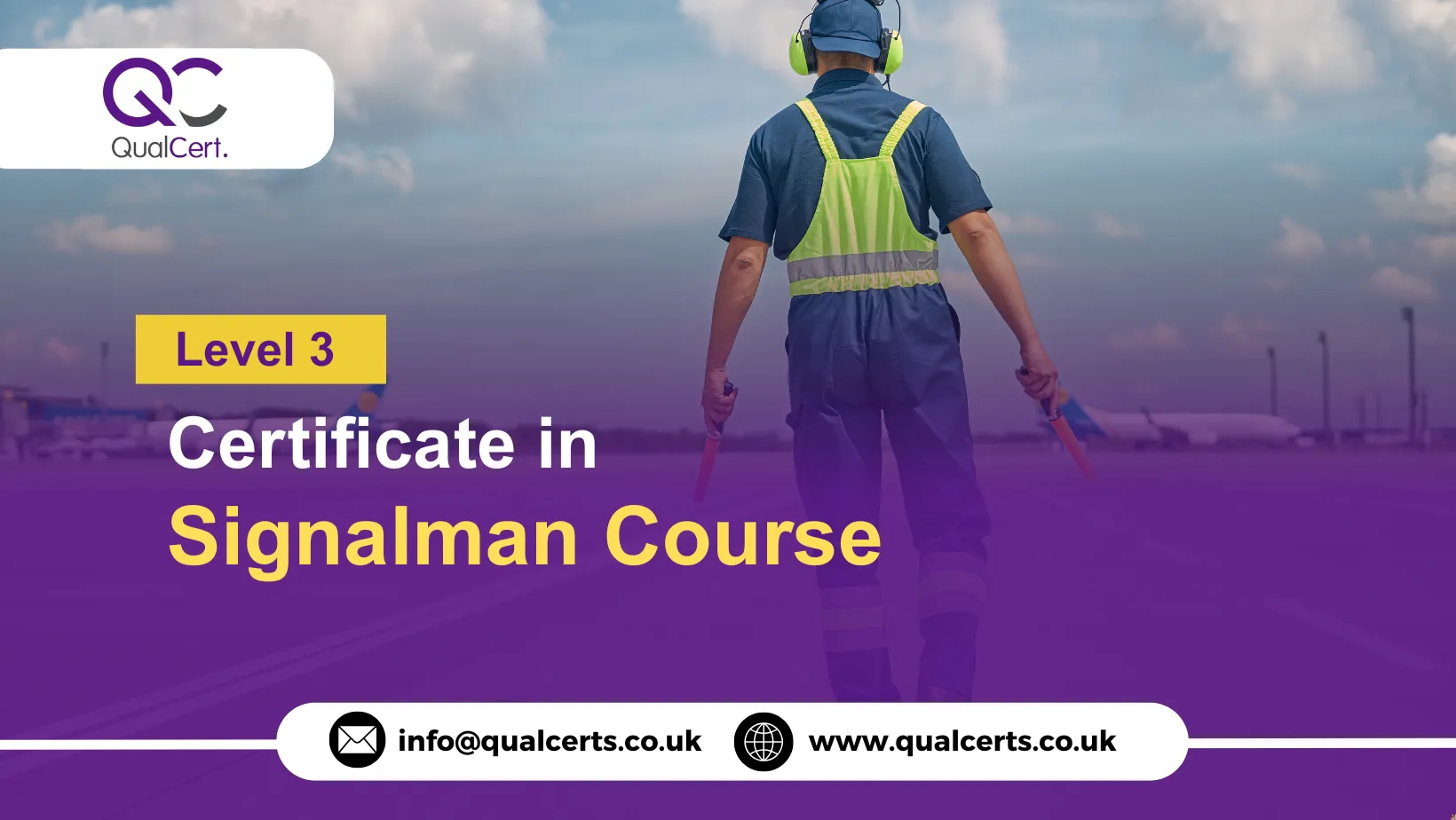
Expert Signalman Training – QualCert Level 3 Certificate
The QualCert Signalman Level 3 Certificate Course is designed for professionals seeking advanced expertise in signaling and lifting operations. This course adheres to UK and international safety standards, ensuring that participants gain the necessary skills to operate in construction, logistics, and industrial sectors where lifting operations are essential. With a focus on safety, efficiency, and regulatory compliance, this certification is ideal for those looking to enhance their career prospects in heavy machinery and lifting coordination.
Effective communication between crane operators and ground personnel is critical in lifting operations. A qualified signalman ensures that operations run smoothly, safely, and efficiently. The Level 3 Certificate is structured to provide participants with comprehensive training in signalling techniques, risk assessment, and compliance with international lifting safety regulations, making it a valuable qualification for professionals in construction, oil and gas, shipping, and heavy industries.
Qualified signalmen play a vital role in ensuring lifting operations are conducted safely and efficiently. With industries such as construction, maritime, manufacturing, and logistics relying heavily on lifting operations, the demand for certified signalmen continues to grow. Completing the QualCert Signalman Level 3 Certificate Course significantly enhances employability, providing participants with a recognized qualification that meets international standards.
The QualCert Signalman Level 3 Certificate Course is your gateway to a rewarding career in lifting operations. With a strong focus on safety, compliance, and technical proficiency, this qualification is highly valued by employers worldwide. By enrolling, you gain specialized skills that set you apart in the industry.
Program Framework
The QualCert Signalman Level 3 Certificate Course offers 20 Credits, requiring a Total Qualification Time (TQT) of 100 hours, including 70 Guided Learning Hours (GLH). This program enhances understanding of complex lifting scenarios, international standards, and regulatory compliance.
| Unit Ref# | Unit Title | Credit | GLH | TQT |
| QC13042-1 | Managing High-Risk Lifting Operations | 4 | 14 | 20 |
| QC13042-2 | Complex Load Movement and Multi-Crane Coordination | 4 | 14 | 20 |
| QC13042-3 | Site Logistics and Operational Planning | 4 | 14 | 20 |
| QC13042-4 | International Safety Standards for Signalmen | 4 | 14 | 20 |
| QC13042-5 | Leadership and Decision-Making in Critical Situations | 4 | 14 | 20 |
Eligibility Criteria
To enrol in the QualCert Signalman Level 3 Certificate Course, candidates must meet the following entry requirements:
- Minimum Age: Candidates must be at least 18 years old.
- Educational Background: A high school diploma or equivalent qualification is recommended.
- Work Experience: Prior experience in lifting operations, signalling, rigging, or construction is highly preferred.
- Language Proficiency: Proficiency in English (or the language of instruction) is essential for understanding safety regulations and communication protocols.
- Physical Fitness: Candidates should be physically fit and capable of working in challenging environments, as the role may involve outdoor work, exposure to heavy machinery, and standing for extended periods.
- Basic Safety Knowledge: A fundamental understanding of health and safety practices related to lifting operations is recommended.
Proficiency Targets
Managing High-Risk Lifting Operations
- Assess and mitigate risks associated with high-risk lifting tasks, ensuring compliance with safety regulations.
- Implement effective communication strategies to coordinate with crane operators, riggers, and ground personnel.
- Apply risk assessment techniques to prevent accidents and ensure safe lifting execution.
Complex Load Movement and Multi-Crane Coordination
- Understand the dynamics of complex load movement, including centre of gravity, load distribution, and swing control.
- Develop expertise in multi-crane lifting operations, ensuring synchronized movement to prevent load instability.
- Coordinate effectively with multiple teams to execute lifts in challenging environments.
Site Logistics and Operational Planning
- Plan and organize lifting operations considering site layout, environmental factors, and machinery positioning.
- Optimize workflow efficiency by integrating logistics, material handling, and workforce allocation.
- Ensure adherence to operational timelines while maintaining safety and productivity.
International Safety Standards for Signalmen
- Demonstrate knowledge of UK and international safety regulations, including LOLER 1998, PUWER 1998, and OSHA guidelines.
- Implement best practices in signalling, crane operation coordination, and hazard identification.
- Maintain compliance with industry standards to ensure worksite safety and legal adherence.
Leadership and Decision-Making in Critical Situations
- Develop situational awareness and make quick, effective decisions in high-pressure lifting operations.
- Lead teams with confidence, ensuring clear communication, coordination, and accountability.
- Handle emergency situations, including equipment failure, environmental hazards, and personnel safety incidents.
Ideal Participants
The QualCert Signalman Level 3 Certificate Course is designed for professionals who play a critical role in lifting operations and site safety. This course is ideal for individuals looking to enhance their expertise in signal communication, risk assessment, and lifting coordination in compliance with UK and international standards.
- Experienced Signalmen – Professionals seeking to advance their knowledge and gain a higher-level certification in signaling and lifting operations.
- Construction and Industrial Workers – Individuals involved in lifting operations, crane coordination, and heavy machinery handling who require formal training.
- Crane Operators and Lifting Supervisors – Those responsible for coordinating lifting activities and ensuring safe communication between ground personnel and crane operators.
- Health and Safety Professionals – Individuals working in safety and compliance roles who need a thorough understanding of lifting operations, risk management, and regulatory compliance.
- Site Managers and Supervisors – Professionals overseeing construction sites, industrial projects, and warehouse operations, ensuring that lifting procedures align with safety regulations.
- Individuals Seeking Career Advancement – Those looking to enhance their employability in industries such as construction, logistics, oil and gas, maritime, and heavy industry.
By completing this course, participants will gain industry-recognized certification, improving their ability to ensure safe and efficient lifting operations while meeting regulatory standards.
Assessment and Verification
Assessment Framework :
The qualification is assessed through a structured Multiple-Choice Question (MCQ)–based examination, designed to measure both theoretical understanding and practical application of knowledge. Key features of the assessment framework include:
- Evidence-Based Assessment:
MCQs are developed using industry-aligned standards to ensure the assessment reflects real-world competencies and current professional practices. - Structured Examination Format:
The exam consists of scenario-based and knowledge-based MCQs, requiring learners to demonstrate critical thinking and subject mastery. - Performance Threshold:
Learners must obtain a minimum score of 70% to successfully complete the qualification. This benchmark ensures that every certified learner meets QualCert’s required level of competence. - Assessment Integrity:
All assessments are conducted under controlled, secure conditions at approved training centres to maintain fairness, consistency, and integrity.
Quality Assurance & Verification :
QualCert applies a comprehensive, multi-layered quality assurance system to uphold international standards and ensure the reliability of all assessment outcomes.
1. Internal Quality Assurance (IQA)
Conducted by the approved training centre:
- Assessment Review:
Centre-approved Assessors and Internal Quality Assurers (IQAs) review learner evidence, scoring accuracy, and compliance with assessment criteria. - Standardisation Activities:
Regular standardisation meetings are conducted within centres to ensure consistent marking practices across all assessors. - Continuous Improvement:
IQAs provide feedback to Assessors to enhance assessment delivery, marking reliability, and learner support.
2. External Quality Assurance (EQA)
Conducted by QualCert:
- Independent Verification:
QualCert External Quality Assurers review a sample of learner assessments to confirm accuracy, consistency, and compliance with QualCert and regulatory standards. - Centre Compliance Audits:
EQAs examine centre procedures, assessor qualifications, assessment environments, and record-keeping to ensure full adherence to quality assurance policies. - Quality and Standards Validation:
EQAs verify that assessment decisions are fair, valid, reliable, and aligned with national and international benchmarks. - Final Approval:
Once the EQA is satisfied that all quality standards have been met, the centre’s results are approved, and QualCert officially releases the certification to the learner.
QualCert delivers all qualifications exclusively through its global network of officially approved training centres.
For registration, guidance, or programme details, please contact your nearest approved training centre.