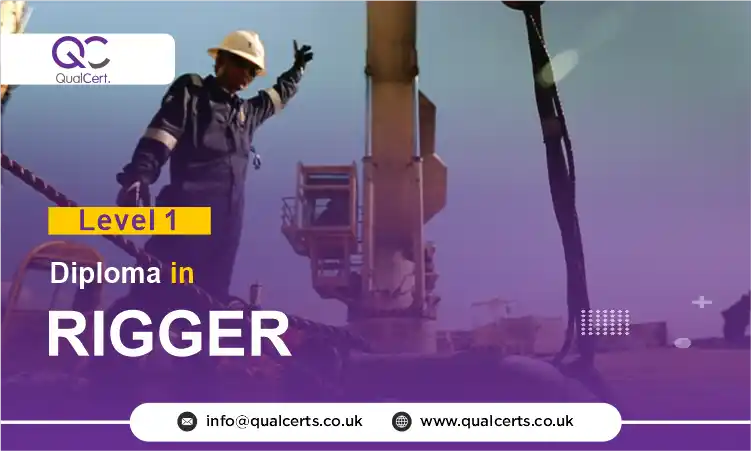
QualCert Rigger Level 1 Diploma – Launch Your Rigging Career
The QualCert Rigger Level 1 Diploma Course is designed for individuals who want to develop fundamental skills and knowledge in rigging operations. This qualification follows UK industry standards and provides a structured approach to learning safe and efficient rigging techniques. It is an ideal starting point for those looking to enter the rigging profession or enhance their existing skills in construction, engineering, and offshore industries.
The QualCert Rigger Level 1 Diploma Course covers essential topics such as the introduction to rigging and lifting equipment, health and safety in rigging operations, rigging techniques and load handling, inspection and maintenance of rigging equipment, and practical rigging applications. The QualCert Rigger Level 1 Diploma Course consists of five study units, with each unit focusing on a key aspect of rigging. Participants will gain a comprehensive understanding of rigging principles, load-handling methods, and the importance of safety compliance.
The course structure includes guided learning hours, self-study, and practical training to ensure a well-rounded educational experience. Learners will be assessed through written tests, practical demonstrations, and instructor observations to confirm their competency in rigging operations. Upon successful completion, candidates will receive the QualCert Level 1 Diploma in Rigging, a recognized qualification that enhances career opportunities in rigging and lifting operations.
The QualCert Rigger Level 1 Diploma Course opens the door to further progression in the field. Individuals can continue their professional development by enrolling in advanced rigging courses such as the QualCert Rigger Level 2 Diploma and the QualCert Rigger Level 3 Diploma, which focus on more complex rigging tasks and supervisory responsibilities. Employers in the construction, oil and gas, and heavy industries priorities workers with accredited training to maintain safety standards and operational efficiency. The QualCert Rigger Level 1 Diploma Course provides learners with the necessary skills to perform rigging tasks safely and effectively, making it a valuable certification for those seeking career growth in this field.
Program Framework
The QualCert Rigger Level 1 Diploma Course offers 30 Credits, requiring a Total Qualification Time (TQT) of 180 hours, including 120 Guided Learning Hours (GLH).This diploma provides a comprehensive introduction to rigging management, safety, and operational techniques.
| Unit Ref# | Unit Title | Credit | GLH | TQT |
| QC13016-1 | Rigging Standards and Workplace Safety | 5 | 20 | 30 |
| QC13016-2 | Rigging Tools, Equipment, and PPE | 5 | 20 | 30 |
| QC13016-3 | Load Characteristics and Risk Factors | 5 | 20 | 30 |
| QC13016-4 | Practical Rigging Procedures | 5 | 20 | 30 |
| QC13016-5 | Crane Signals and Load Movement Coordination | 5 | 20 | 30 |
| QC13016-6 | Case Studies and Practical Assessments | 5 | 20 | 30 |
Eligibility Criteria
The QualCert Rigger Level 1 Diploma is designed for individuals starting their career in rigging and lifting operations. Candidates should meet the following criteria:
- Age Requirement: Must be 18 years or older.
- Educational Background: Minimum of GCSEs or equivalent in English and Mathematics; basic literacy and numeracy are essential.
- Work Experience: No prior experience is required, but basic exposure to construction or manual handling is advantageous.
- Language Proficiency: Must have proficient English skills, both written and spoken, to follow instructions, safety guidelines, and course materials.
Proficiency Targets
The QualCert Rigger Level 1 Diploma Course is designed to provide learners with the foundational knowledge and practical skills necessary to perform rigging tasks safely and efficiently. Upon successful completion of the course, learners will be able to:
Rigging Standards and Workplace Safety
- Demonstrate an understanding of UK rigging regulations, including LOLER (Lifting Operations and Lifting Equipment Regulations) and PUWER (Provision and Use of Work Equipment Regulations).
- Identify workplace hazards related to rigging operations and apply appropriate control measures.
- Follow risk assessment procedures and comply with site-specific safety policies.
Rigging Tools, Equipment, and PPE
- Identify and correctly use rigging tools such as slings, shackles, hoists, and wire ropes.
- Conduct pre-use inspections of rigging equipment to ensure safety and functionality.
Load Characteristics and Risk Factors
- Understand the principles of load weight estimation, centre of gravity, and balance.
- Assess load stability and apply appropriate rigging techniques for safe lifting.
- Identify environmental and operational risk factors that may affect load movement.
- Apply load securing methods to prevent shifting or imbalance during lifting operations.
Practical Rigging Procedures
- Apply basic rigging techniques to safely attach, secure, and control loads.
- Demonstrate proper lifting, lowering, and securing methods in compliance with UK rigging best practices.
- Conduct routine checks on rigging setups to ensure safety and efficiency.
Crane Signals and Load Movement Coordination
- Understand and demonstrate standard hand and radio signals used in crane operations.
- Communicate effectively with crane operators and rigging team members to coordinate load movements.
- Recognize potential hazards in load movement and take corrective actions as needed.
Case Studies and Practical Assessments
- Apply theoretical knowledge to real-world rigging scenarios through case studies.
- Demonstrate practical competency in rigging techniques under supervised assessment conditions.
- Identify common rigging mistakes and apply corrective measures to improve safety and efficiency.
Ideal Participants
The QualCert Rigger Level 1 Diploma Course is designed for individuals seeking to develop foundational skills in rigging operations. This course is suitable for:
- Aspiring Riggers – Individuals looking to enter the rigging profession with a recognised qualification.
- Construction and Industrial Workers – Those working in construction, engineering, manufacturing, and related industries who require rigging knowledge.
- Oil, Gas, and Offshore Industry Personnel – Workers involved in offshore and heavy industry operations where rigging and lifting tasks are essential.
- Warehouse and Logistics Workers – Employees handling heavy loads and lifting equipment in warehouses and storage facilities.
- Military and Ex-Forces Personnel – Individuals transitioning from military service who want to apply their experience in a civilian rigging role.
- Health and Safety Professionals – Safety officers and supervisors looking to understand rigging safety to enhance workplace compliance.
This course provides a solid foundation for those new to the field and offers essential training for workers looking to improve their competency in rigging operations.
Assessment and Verification
Assessment Framework :
This qualification consists of 6 mandatory assignments designed to assess the learner’s understanding and practical application of the required skills and knowledge. The key elements of the assessment framework include:
- Comprehensive Assignment Structure:
The assignments are designed to cover a range of topics within the qualification, ensuring that learners demonstrate their competence across all essential areas. - Pass Requirement:
Learners must successfully complete all 6 assignments to meet the requirements for certification. Each assignment must meet the specified criteria and demonstrate sufficient understanding and application of the subject matter. - Assessment Process:
Each assignment is reviewed and marked by a qualified assessor, with feedback provided to support learner development. - Final Completion Criteria:
The successful completion of all assignments is necessary for certification. Only learners who meet the required standards across all assignments will be awarded the qualification.
Quality Assurance & Verification:
QualCert applies a rigorous, multi-layered quality assurance system to ensure the reliability, consistency, and integrity of all assessments and results.
1. Internal Quality Assurance (IQA)
Conducted by the approved training centre:
- Assignment Evaluation:
Centre-approved Assessors and Internal Quality Assurers (IQAs) review the assignments to ensure they meet the assessment criteria and learning outcomes. - Standardisation:
Regular standardisation sessions are held to maintain consistency in assessment and marking practices across all centre staff. - Feedback & Support:
IQAs ensure that learners receive constructive feedback to aid their progress and improve future submissions.
2. External Quality Assurance (EQA)
Conducted by QualCert:
- Independent Verification:
QualCert’s External Quality Assurers (EQAs) verify the completed assignments and assess the quality and fairness of the marking process. - Centre Audits:
EQAs audit the centre’s compliance with QualCert’s quality assurance standards, reviewing assessment practices, learner records, and overall delivery. - Final Certification:
After satisfying the EQA’s verification process, QualCert will officially issue the certification to the learner.
QualCert delivers all qualifications exclusively through its network of officially approved training centres.
For registration or further information, please contact