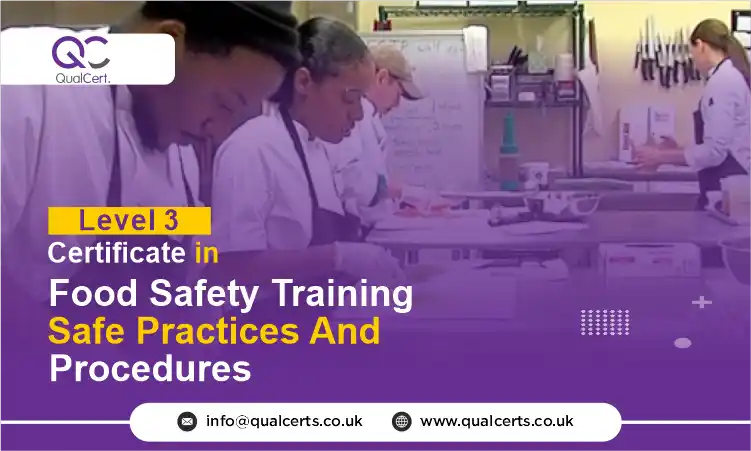
Master QualCert Level 3 Food Safety Training Expert
The QualCert Level 3 Certificate in Food Safety Training – Safe Practices and Procedures is designed to provide advanced knowledge and skills essential for ensuring food safety in various food handling environments. The QualCert Level 3 Certificate in Food Safety Training – Safe Practices and Procedures is ideal for food industry professionals, supervisors, and managers who are responsible for maintaining high food hygiene standards and ensuring compliance with international food safety regulations.
The QualCert Level 3 Certificate in Food Safety Training – Safe Practices and Procedures is a critical aspect of public health, and this course covers advanced topics such as HACCP principles, food safety management systems, risk assessment, and foodborne illness prevention. Learners will gain in-depth knowledge of food safety laws, proper food handling practices, contamination prevention, and the legal responsibilities of food business operators. Throughout the QualCert Level 3 Certificate in Food Safety Training – Safe Practices and Procedures, participants will explore key areas such as food safety audits, inspections, pest control, and facility hygiene.
By understanding the principles of risk assessment and hazard control, learners will be able to implement effective food safety policies and procedures within their organizations. The QualCert Level 3 Certificate in Food Safety Training – Safe Practices and Procedures helps professionals develop the competencies required to manage food safety risks and ensure compliance with legal requirements. By completing this course, learners will be well-equipped to take on leadership roles in food businesses, ensuring that food safety practices are maintained at the highest standards.
The QualCert Level 3 Certificate in Food Safety Training – Safe Practices and Procedures is essential for those looking to advance their careers in food safety, quality assurance, and regulatory compliance. By gaining a strong foundation in food safety management, learners will be well-prepared to take on senior roles in the food industry, ensuring that public health and consumer safety remain top priorities. The course provides practical guidance on safe food handling, sanitation, pest control, and facility hygiene, ensuring that learners can apply best practices in real-world food industry settings.
Program Framework
The QualCert Level 3 Certificate in Food Safety Training – Safe Practices and Procedures offers 20 Credits, requiring a Total Qualification Time (TQT) of 100 hours, including 70 Guided Learning Hours (GLH). This comprehensive certificate program provides expert knowledge on food safety, HACCP systems, and regulatory inspections.
| Unit Ref# | Unit Title | Credit | GLH | TQT |
| QC16012-1 | Food Safety Management Systems (HACCP) | 4 | 14 | 20 |
| QC16012-2 | Foodborne Illnesses and Prevention Strategies | 4 | 14 | 20 |
| QC16012-3 | Pest Control and Facility Hygiene | 4 | 14 | 20 |
| QC16012-4 | Legal Responsibilities of Food Handlers and Managers | 4 | 14 | 20 |
| QC16012-5 | Food Safety Audits and Inspections | 4 | 14 | 20 |
Eligibility Criteria
To enroll in the QualCert Level 3 Certificate in Food Safety Training – Safe Practices and Procedures, :Candidates must meet the following requirements:
- Minimum Age Requirement-:Candidates must be at least 18 years old at the time of enrolment.
- Educational Qualification-A basic understanding of English is required to follow instructions, complete assessments, and engage effectively in the training.
- Prior Knowledge-It is recommended that :Candidates have completed a Level 2 qualification in food safety or have relevant industry experience. However, this is not mandatory.
- Workplace Suitability-This course is ideal for individuals working in supervisory or managerial roles within the food industry, including restaurants, catering services, food production, and retail establishments.
- Physical Fitness-:Candidates should be physically capable of participating in practical training elements, such as hygiene and food handling procedures.
Proficiency Targets
This course provides learners with the skills and knowledge to manage food safety risks, implement hygiene standards, and ensure compliance with food safety regulations.
Food Safety Management Systems (HACCP)
- Understand the principles and importance of Hazard Analysis and Critical Control Points (HACCP).
- Identify critical control points (CCPs) in food production and implement monitoring procedures.
- Develop and apply HACCP-based food safety management systems in various food industry settings.
Foodborne Illnesses and Prevention Strategies
- Identify common foodborne pathogens and their sources.
- Understand the causes and symptoms of foodborne illnesses and how to prevent outbreaks.
- Implement effective hygiene and sanitation practices to reduce the risk of contamination.
Pest Control and Facility Hygiene
- Recognize common pests in food facilities and understand the risks they pose to food safety.
- Implement pest prevention and control measures in compliance with food safety regulations.
- Maintain high standards of facility hygiene through proper cleaning and sanitation protocols.
Legal Responsibilities of Food Handlers and Managers
- Understand national and international food safety laws and regulations.
- Recognize the legal obligations of food handlers and managers in ensuring food safety compliance.
- Implement procedures to meet legal standards and avoid penalties for non-compliance.
Food Safety Audits and Inspections
- Understand the purpose and process of food safety audits and regulatory inspections.
- Prepare food establishments for internal and external audits.
- Identify and correct non-compliance issues to maintain high food safety standards.
Ideal Participants
The QualCert Level 3 Certificate in Food Safety Training – Safe Practices and Procedures is designed for individuals responsible for managing and overseeing food safety standards in the food industry. This course is ideal for:
- Food Safety Supervisors and Managers who oversee hygiene and safety practices in food businesses.
- Restaurant and Catering Professionals responsible for ensuring compliance with food safety regulations.
- Food Production and Processing Staff involved in maintaining high safety standards in food manufacturing.
- Quality Assurance and Compliance Officers ensuring adherence to national and international food safety laws.
- Retail and Hospitality Industry Professionals handling food products and ensuring safe storage, handling, and preparation.
- Health Inspectors and Regulatory Officers looking to enhance their knowledge of food safety management systems.
- Individuals Seeking Career Advancement in food safety, quality control, or regulatory compliance within the food industry.
Assessment and Verification
Assessment Framework :
The qualification is assessed through a structured Multiple-Choice Question (MCQ)–based examination, designed to measure both theoretical understanding and practical application of knowledge. Key features of the assessment framework include:
- Evidence-Based Assessment:
MCQs are developed using industry-aligned standards to ensure the assessment reflects real-world competencies and current professional practices. - Structured Examination Format:
The exam consists of scenario-based and knowledge-based MCQs, requiring learners to demonstrate critical thinking and subject mastery. - Performance Threshold:
Learners must obtain a minimum score of 70% to successfully complete the qualification. This benchmark ensures that every certified learner meets QualCert’s required level of competence. - Assessment Integrity:
All assessments are conducted under controlled, secure conditions at approved training centres to maintain fairness, consistency, and integrity.
Quality Assurance & Verification :
QualCert applies a comprehensive, multi-layered quality assurance system to uphold international standards and ensure the reliability of all assessment outcomes.
1. Internal Quality Assurance (IQA)
Conducted by the approved training centre:
- Assessment Review:
Centre-approved Assessors and Internal Quality Assurers (IQAs) review learner evidence, scoring accuracy, and compliance with assessment criteria. - Standardisation Activities:
Regular standardisation meetings are conducted within centres to ensure consistent marking practices across all assessors. - Continuous Improvement:
IQAs provide feedback to Assessors to enhance assessment delivery, marking reliability, and learner support.
2. External Quality Assurance (EQA)
Conducted by QualCert:
- Independent Verification:
QualCert External Quality Assurers review a sample of learner assessments to confirm accuracy, consistency, and compliance with QualCert and regulatory standards. - Centre Compliance Audits:
EQAs examine centre procedures, assessor qualifications, assessment environments, and record-keeping to ensure full adherence to quality assurance policies. - Quality and Standards Validation:
EQAs verify that assessment decisions are fair, valid, reliable, and aligned with national and international benchmarks. - Final Approval:
Once the EQA is satisfied that all quality standards have been met, the centre’s results are approved, and QualCert officially releases the certification to the learner.
QualCert delivers all qualifications exclusively through its global network of officially approved training centres.
For registration, guidance, or programme details, please contact your nearest approved training centre.