Advanced Paediatric First Aid – Level 3 PFA Award
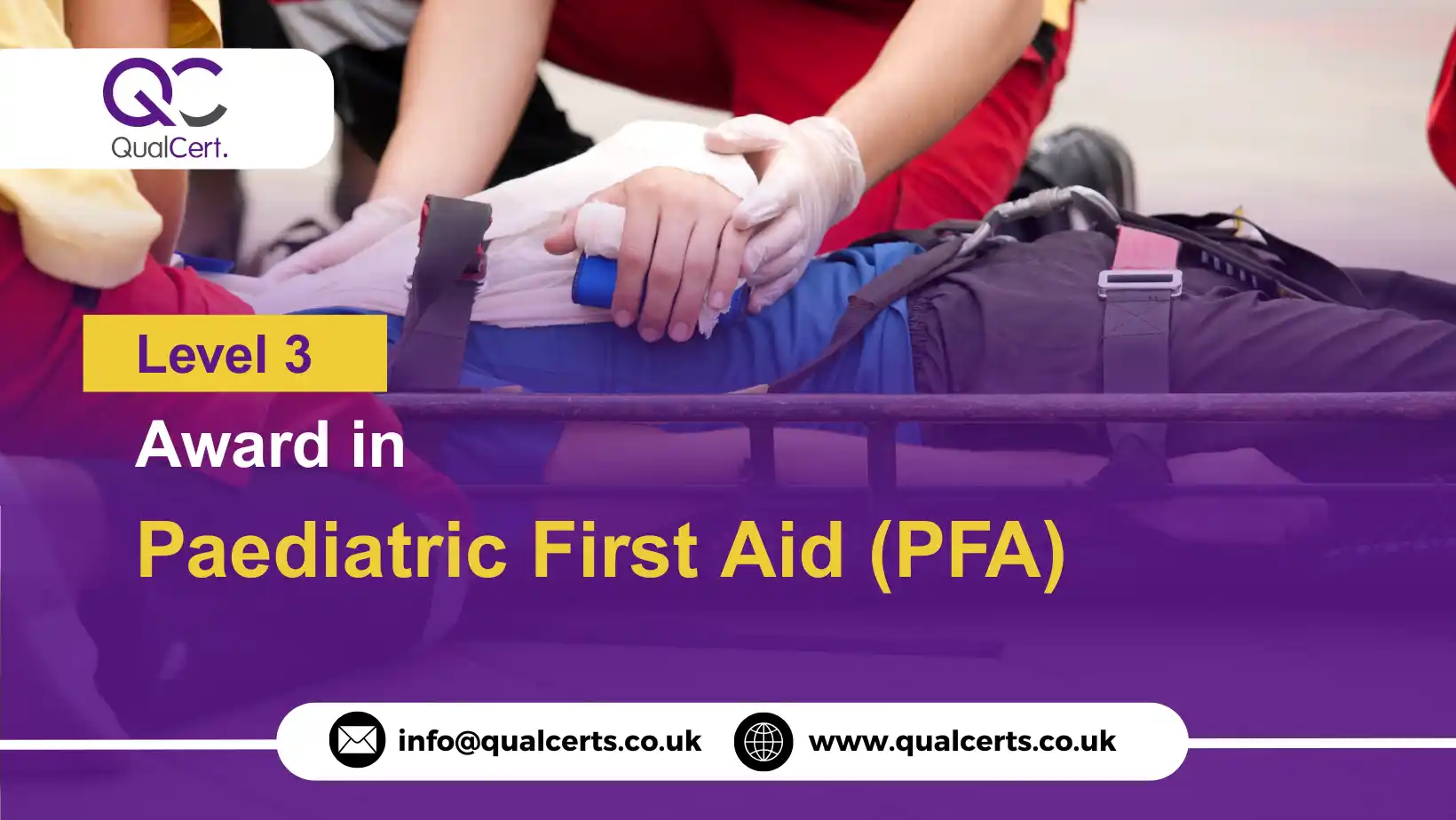
The QualCert Level 3 Award in Paediatric First Aid (PFA) is a specialized certification designed to equip candidates with the knowledge and practical skills needed to respond effectively to medical emergencies involving infants and young children. This course focuses on essential paediatric first aid techniques, including CPR, choking management, bleeding control, burns, fractures, and other common emergencies affecting children.
Ideal for childcare professionals, teachers, supervisors, and anyone responsible for the safety of children in workplaces or educational settings, this award combines theoretical learning with hands-on practical training. Candidates gain the confidence and competence to act quickly and safely during emergencies, ensuring the well-being of children until professional medical help arrives.
By completing the QualCert Level 3 Award in Paediatric First Aid (PFA), candidates enhance their ability to provide immediate, life-saving care and improve overall child safety. This qualification is recognized internationally and meets high standards for professional paediatric first aid training, making it essential for anyone working with children in professional, educational, or childcare environments.
Program Framework
The QualCert Level 3 Award in Paediatric First Aid (PFA), offers 6 Credits, requiring a Total Qualification Time (TQT) of 30 hours, including 18 Guided Learning Hours (GLH).
| Unit Ref# | Unit Title | Credit | GLH | TQT |
| QC14020-1 | Understanding the Role and Responsibilities of the Paediatric First Aider | 1 | 3 | 5 |
| QC14020-2 | Assessing an Emergency Situation and Providing Appropriate Response | 1 | 3 | 5 |
| QC14020-3 | Administering CPR and Using an Automated External Defibrillator (AED) | 1 | 3 | 5 |
| QC14020-4 | Providing First Aid to an Unresponsive Infant or Child | 1 | 3 | 5 |
| QC14020-5 | Managing Illnesses, Injuries, and Medical Conditions in Children | 1 | 3 | 5 |
| QC14020-6 | Managing Acute Medical Emergencies and Reporting Procedures | 1 | 3 | 5 |
Eligibility Criteria
Proficiency Targets
Understanding the Role and Responsibilities of the Paediatric First Aider
- Importance of acting safely and promptly in an emergency
- Understanding workplace and legal responsibilities (including EYFS and Ofsted)
- Awareness of infection control and first aider limitations
- Importance of accurate incident reporting and record keeping
Assessing an Emergency Situation and Providing Appropriate Response
- Conducting a scene assessment (ensuring safety for self and others)
- Performing a primary survey (DRABC approach)
- Prioritising treatment for life-threatening conditions
- Understanding the recovery position and its appropriate use
Administering CPR and Using an Automated External Defibrillator (AED)
- Performing CPR on infants and children in accordance with Resuscitation Council UK guidelines
- Safe and correct use of an AED on children
- Coordination with emergency services during resuscitation
Providing First Aid to an Unresponsive Infant or Child
- Identifying levels of consciousness
- Placing infants and children in the recovery position
- Ongoing monitoring and reassessment until professional help arrives
Managing Illnesses, Injuries, and Medical Conditions in Children
- Treating wounds, external bleeding, and burns
- Recognising and managing head injuries and fractures
- Treating bites, stings, nosebleeds, sprains, and other common injuries
- First aid for chronic conditions such as asthma, diabetes, and epilepsy
Managing Acute Medical Emergencies and Reporting Procedures
- Recognising signs of serious illness (e.g., meningitis, febrile convulsions, allergic reactions)
- Administering appropriate first aid for anaphylaxis (including use of auto-injectors)
- Understanding reporting requirements, parental notification, and safeguarding responsibilities
- Supporting the emotional needs of children post-incident
Ideal Participants
The QualCert Level 3 Award in Paediatric First Aid (PFA) is specifically designed for individuals who have a duty of care towards infants and children in professional, educational, or voluntary settings.
This course is suitable for:
- Early years practitioners working in nurseries, pre-schools, and daycare centres
- Primary school teachers, classroom assistants, and support staff
- Registered childminders, nannies, and au pairs providing home-based childcare
- Out-of-school care providers, including after-school and holiday club staff
- Sports coaches, activity leaders, and those running children’s clubs or youth groups
- Foster carers and staff working in residential childcare settings
- Trainees and apprentices entering the childcare or education sector
- Parents and guardians seeking formal first aid knowledge to support their family
This qualification is particularly relevant for those working in settings regulated by Ofsted and required to meet the Early Years Foundation Stage (EYFS) statutory framework. It also serves as a strong professional development asset for individuals seeking to enhance their childcare CV or meet employment requirements in early years and educational roles.
Assessment and Verification
Assessment Framework :
The qualification is assessed through a structured Multiple-Choice Question (MCQ)–based examination, designed to measure both theoretical understanding and practical application of knowledge. Key features of the assessment framework include:
- Evidence-Based Assessment:
MCQs are developed using industry-aligned standards to ensure the assessment reflects real-world competencies and current professional practices. - Structured Examination Format:
The exam consists of scenario-based and knowledge-based MCQs, requiring learners to demonstrate critical thinking and subject mastery. - Performance Threshold:
Learners must obtain a minimum score of 70% to successfully complete the qualification. This benchmark ensures that every certified learner meets QualCert’s required level of competence. - Assessment Integrity:
All assessments are conducted under controlled, secure conditions at approved training centres to maintain fairness, consistency, and integrity.
Quality Assurance & Verification :
QualCert applies a comprehensive, multi-layered quality assurance system to uphold international standards and ensure the reliability of all assessment outcomes.
1. Internal Quality Assurance (IQA)
Conducted by the approved training centre:
- Assessment Review:
Centre-approved Assessors and Internal Quality Assurers (IQAs) review learner evidence, scoring accuracy, and compliance with assessment criteria. - Standardisation Activities:
Regular standardisation meetings are conducted within centres to ensure consistent marking practices across all assessors. - Continuous Improvement:
IQAs provide feedback to Assessors to enhance assessment delivery, marking reliability, and learner support.
2. External Quality Assurance (EQA)
Conducted by QualCert:
- Independent Verification:
QualCert External Quality Assurers review a sample of learner assessments to confirm accuracy, consistency, and compliance with QualCert and regulatory standards. - Centre Compliance Audits:
EQAs examine centre procedures, assessor qualifications, assessment environments, and record-keeping to ensure full adherence to quality assurance policies. - Quality and Standards Validation:
EQAs verify that assessment decisions are fair, valid, reliable, and aligned with national and international benchmarks. - Final Approval:
Once the EQA is satisfied that all quality standards have been met, the centre’s results are approved, and QualCert officially releases the certification to the learner.
QualCert delivers all qualifications exclusively through its global network of officially approved training centres.
For registration, guidance, or programme details, please contact your nearest approved training centre.