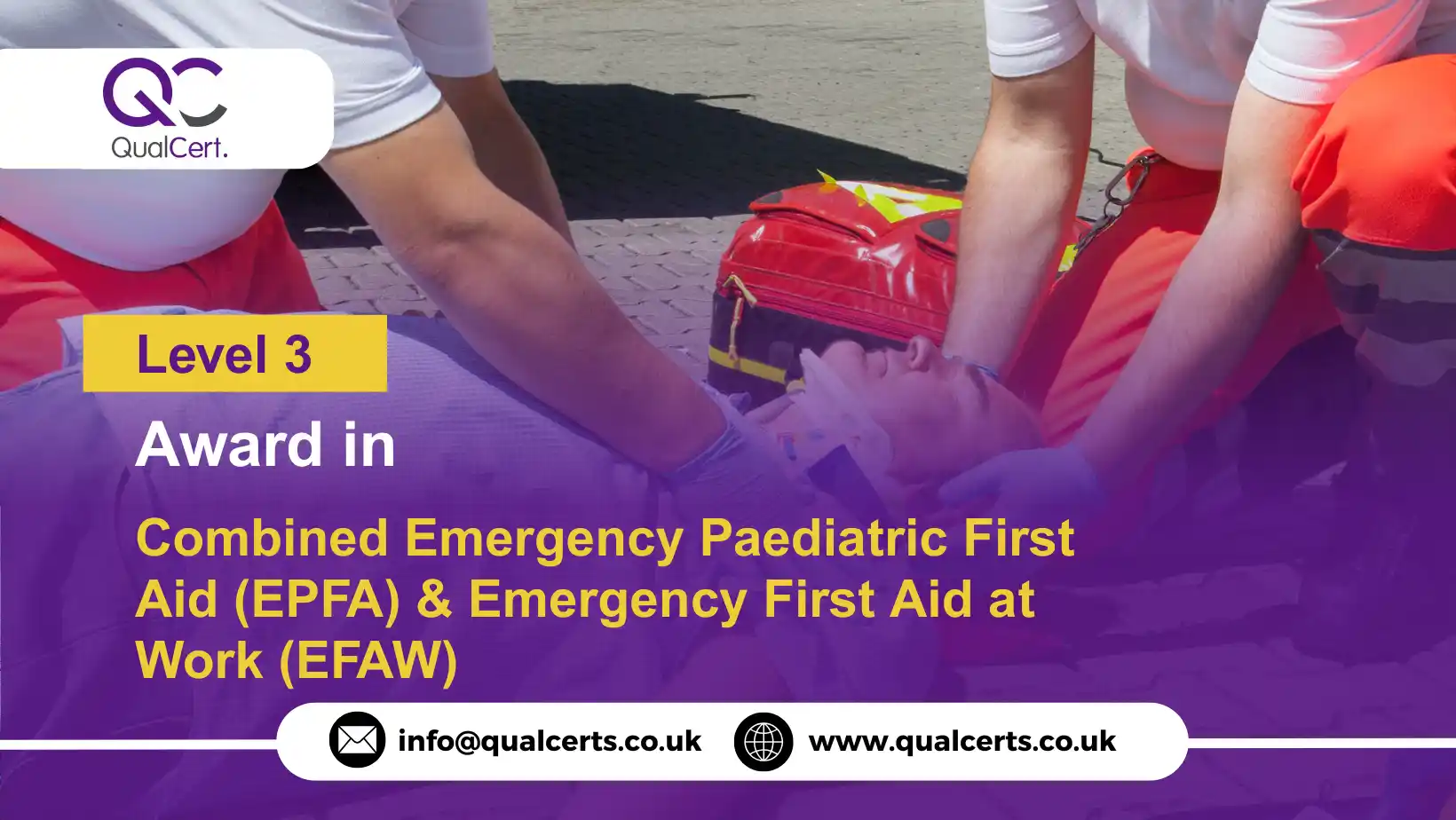
Empower Teams: Level 3 EPFA & EFAW Emergency Training
The QualCert Level 3 Award in Combined Emergency Paediatric First Aid (EPFA) and Emergency First Aid at Work (EFAW) is designed to meet this need by providing a complete, one-day training solution for professionals who require first aid competency in both workplace and childcare environments.This combined course offers a practical, efficient option for those seeking to meet statutory obligations under the Health and Safety (First-Aid) Regulations 1981 and the Early Years Foundation Stage (EYFS) framework.
The QualCert Level 3 Award in Combined Emergency Paediatric First Aid and Emergency First Aid at Work brings together two essential qualifications in a single, streamlined programme. It equips learners with the knowledge and hands-on skills needed to respond confidently to emergency situations involving adults, children, and infants.This course is delivered over one day and is ideal for staff who work in mixed environments, such as schools, nurseries, sports clubs, hospitality venues, and community centres. Upon successful completion, learners receive certification for both emergency paediatric first aid and workplace first aid.
The QualCert Level 3 Award in Combined Emergency Paediatric First Aid and Emergency First Aid at Work is a smart, practical solution for professionals working across multiple care settings. It supports legal compliance, enhances safety culture, and empowers staff with the confidence to act in emergency situations involving any age group.
Program Framework
The QualCert Level 3 Award in Combined Emergency Paediatric First Aid (EPFA) & Emergency First Aid at Work (EFAW), offers 6 Credits, requiring a Total Qualification Time (TQT) of 30 hours, including 18 Guided Learning Hours (GLH).
| Unit Ref# | Unit Title | Credit | GLH | TQT |
| QC14021-1 | Understanding the Role and Responsibilities of the Emergency First Aider | 1 | 3 | 5 |
| QC14021-2 | Assessing an Emergency Situation and Acting Safely | 1 | 3 | 5 |
| QC14021-3 | Providing First Aid to an Unresponsive Adult, Infant, or Child | 1 | 3 | 5 |
| QC14021-4 | Administering CPR and Using an Automated External Defibrillator (AED) | 1 | 3 | 5 |
| QC14021-5 | Managing Choking, Bleeding, and Shock in Adults and Children | 1 | 3 | 5 |
| QC14021-6 | Managing Minor Injuries, Illnesses, and Medical Emergencies | 1 | 3 | 5 |
Eligibility Criteria
The QualCert Level 3 Award in Combined Emergency Paediatric First Aid (EPFA) & Emergency First Aid at Work (EFAW) is designed for candidates who want to gain comprehensive first aid skills for both children and adults in workplace and professional settings. The following entry requirements ensure candidates are fully prepared for the course:
- Minimum Age: Candidates must be at least 16 years old or meet local workplace training regulations.
- Educational Background: Candidates should have basic literacy and comprehension skills to understand course materials and complete assessments.
- Experience: No prior first aid experience is required, though familiarity with childcare, workplace safety, or emergency procedures is advantageous.
- Professional Experience: Suitable for employees, supervisors, safety officers, childcare staff, teachers, and anyone responsible for health and safety in workplaces or childcare settings.
- Language Proficiency: Candidates should have sufficient English proficiency to follow instructions, read course content, and actively participate in practical sessions.
Proficiency Targets
Understanding the Role and Responsibilities of the Emergency First Aider
- Define the role and responsibilities of a first aider in workplace and paediatric settings
- Understand legal requirements including Health and Safety (First-Aid) Regulations 1981 and EYFS
- Explain infection prevention, personal safety, and use of personal protective equipment (PPE)
- Importance of accurate incident recording and confidentiality
- Identify emergency equipment and its correct usage
Unit 2: Assessing an Emergency Situation and Acting Safely
- Conduct scene safety assessment for self, casualty, and bystanders
- Perform a primary survey using DRABC (Danger, Response, Airway, Breathing, Circulation)
- Prioritise action based on casualty condition and severity
- Recognise when and how to call emergency medical services
- Effective communication during an emergency
Providing First Aid to an Unresponsive Adult, Infant, or Child
- Recognise levels of consciousness across different age groups
- Place unresponsive individuals in the recovery position (adult, child, infant)
- Monitor breathing and respond to changes
- Recognise and respond to agonal breathing
- Provide continuous care until professional help arrives
Administering CPR and Using an Automated External Defibrillator (AED)
- Perform CPR for adults, children, and infants following Resuscitation Council UK guidelines
- Understand differences in compression depth and rate between age groups
- Correct use of AED including pad placement and safety precautions
- Coordination with emergency responders during resuscitation
- Post-resuscitation care
Managing Choking, Bleeding, and Shock in Adults and Children
- Recognise partial and complete airway obstructions in adults and children
- Perform appropriate choking relief techniques for each age group
- Control external bleeding using direct pressure and dressings
- Identify signs of shock and provide first aid treatment
- Monitor and support casualty’s condition during recovery
Managing Minor Injuries, Illnesses, and Medical Emergencies
- Provide first aid for minor wounds, burns, scalds, bites, and stings
- Recognise and manage common medical conditions including asthma, diabetes, epilepsy, and allergic reactions
- Use of auto-injectors for anaphylaxis
- Manage febrile convulsions and seizure episodes
- Understand safeguarding responsibilities and incident reporting protocols
Ideal Participants
The Level 3 Award in Combined Emergency Paediatric First Aid (EPFA) & Emergency First Aid at Work (EFAW) is ideal for individuals who need comprehensive first aid training covering both adults and children. This combined qualification suits professionals working in environments where they may be responsible for the safety and wellbeing of both age groups.
This course is particularly suitable for:
- Early years practitioners, nursery staff, and childminders
- School teachers, teaching assistants, and support staff
- Childcare providers and foster carers
- Workplace first aiders who work in family-oriented settings or with children
- Sports coaches, activity leaders, and youth group volunteers
- Staff in hospitality, leisure, and community centres with mixed-age groups
- Employers and employees looking to meet legal first aid requirements efficiently
- Anyone seeking a time-effective way to gain both paediatric and adult emergency first aid skills
By completing this course, learners will be well-equipped to confidently manage a variety of emergency situations, ensuring the safety of both children and adults in their care.
Assessment and Verification
Assessment Framework :
The qualification is assessed through a structured Multiple-Choice Question (MCQ)–based examination, designed to measure both theoretical understanding and practical application of knowledge. Key features of the assessment framework include:
- Evidence-Based Assessment:
MCQs are developed using industry-aligned standards to ensure the assessment reflects real-world competencies and current professional practices. - Structured Examination Format:
The exam consists of scenario-based and knowledge-based MCQs, requiring learners to demonstrate critical thinking and subject mastery. - Performance Threshold:
Learners must obtain a minimum score of 70% to successfully complete the qualification. This benchmark ensures that every certified learner meets QualCert’s required level of competence. - Assessment Integrity:
All assessments are conducted under controlled, secure conditions at approved training centres to maintain fairness, consistency, and integrity.
Quality Assurance & Verification :
QualCert applies a comprehensive, multi-layered quality assurance system to uphold international standards and ensure the reliability of all assessment outcomes.
1. Internal Quality Assurance (IQA)
Conducted by the approved training centre:
- Assessment Review:
Centre-approved Assessors and Internal Quality Assurers (IQAs) review learner evidence, scoring accuracy, and compliance with assessment criteria. - Standardisation Activities:
Regular standardisation meetings are conducted within centres to ensure consistent marking practices across all assessors. - Continuous Improvement:
IQAs provide feedback to Assessors to enhance assessment delivery, marking reliability, and learner support.
2. External Quality Assurance (EQA)
Conducted by QualCert:
- Independent Verification:
QualCert External Quality Assurers review a sample of learner assessments to confirm accuracy, consistency, and compliance with QualCert and regulatory standards. - Centre Compliance Audits:
EQAs examine centre procedures, assessor qualifications, assessment environments, and record-keeping to ensure full adherence to quality assurance policies. - Quality and Standards Validation:
EQAs verify that assessment decisions are fair, valid, reliable, and aligned with national and international benchmarks. - Final Approval:
Once the EQA is satisfied that all quality standards have been met, the centre’s results are approved, and QualCert officially releases the certification to the learner.
QualCert delivers all qualifications exclusively through its global network of officially approved training centres.
For registration, guidance, or programme details, please contact your nearest approved training centre.