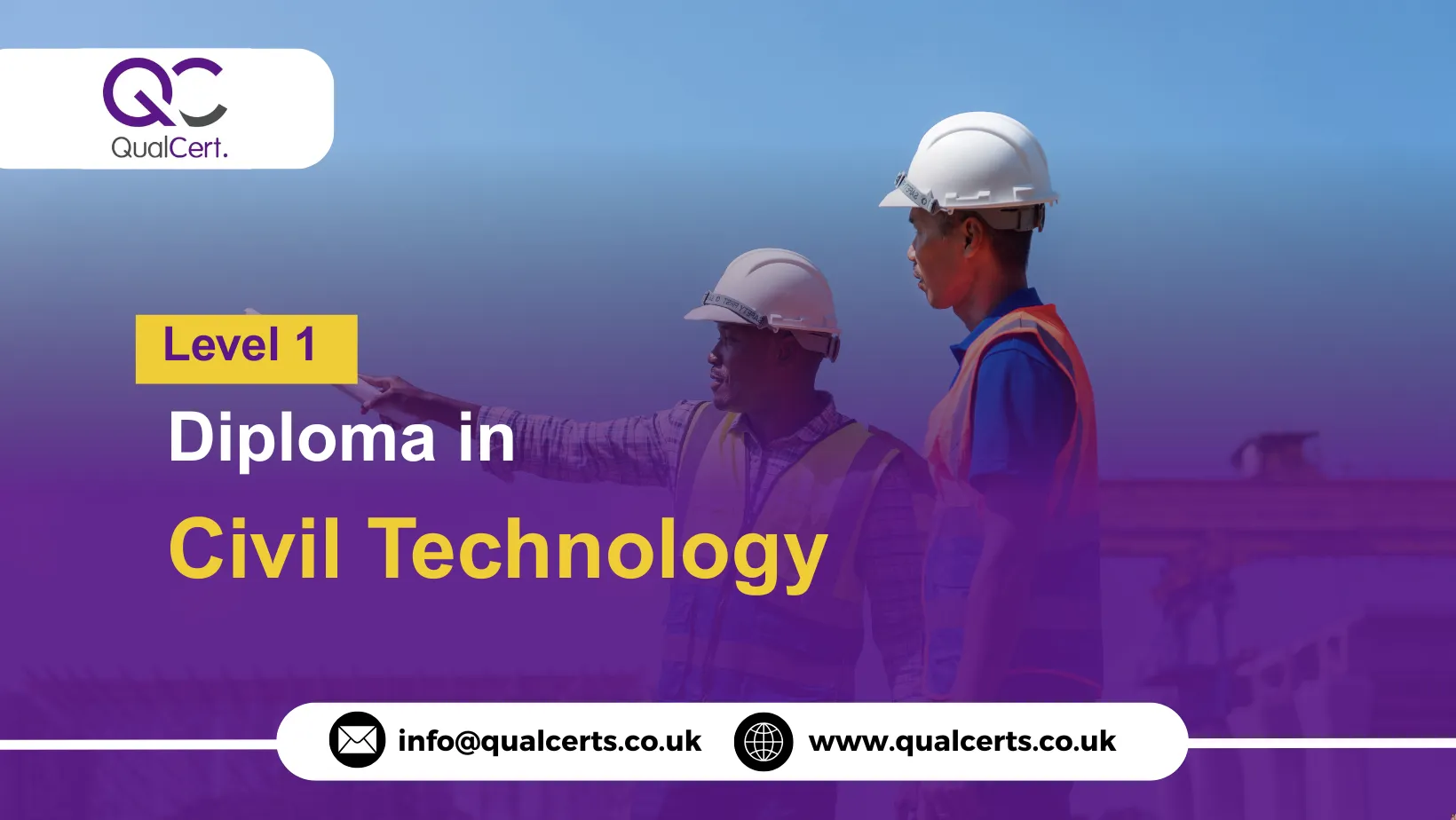
QualCert Level 1 Civil Technology Diploma – Practical Pathway
The QualCert Level 1 Diploma in Civil Technology is a comprehensive foundational program designed to introduce learners to the essential principles of civil engineering technology. This course thoughtfully combines theoretical understanding with practical application, enabling students to build a strong knowledge base while developing industry-relevant skills. It is ideal for individuals seeking to begin their journey in civil engineering and related technical fields with confidence and clarity.
More than an introductory qualification, this diploma delivers a structured and engaging learning experience focused on modern engineering practices. Learners are introduced to key concepts such as structural fundamentals, surveying methods, and Computer-Aided Design (CAD). The program emphasizes accuracy, innovation, and technical awareness, helping students understand how civil technology supports infrastructure development in real-world environments.
The curriculum also highlights the importance of safety regulations, ethical conduct, and professional responsibility within engineering settings. Alongside technical competencies, students enhance their communication, teamwork, and problem-solving skills—essential attributes for collaborative work environments. Upon completion, learners will possess a solid foundation for further study or entry-level roles, positioning the QualCert Level 1 Diploma in Civil Technology as a valuable stepping stone toward a successful and future-focused career in civil engineering.
Program Framework
The QualCert Level 1 Diploma in Civil Technology is a 30-credit qualification with a Total Qualification Time (TQT) of 180 hours, including 120 Guided Learning Hours (GLH). This course is thoughtfully designed to provide targeted and efficient skill development in the field of Civil, offering learners a solid foundation to build their expertise.
| Unit Ref# | Unit Title | Credit | GLH | TQT |
| QC02001 – 1 | Introduction to Civil Technology | 5 | 20 | 30 |
| QC02001 – 2 | Construction Materials | 5 | 20 | 30 |
| QC02001 – 3 | Technical Drawing Basics | 5 | 20 | 30 |
| QC02001 – 4 | Health, Safety, and Environment | 5 | 20 | 30 |
| QC02001 – 5 | Basic Surveying | 5 | 20 | 30 |
| QC02001 – 6 | Mathematics for Civil Technology | 5 | 20 | 30 |
Eligibility Criteria
The QualCert Level 1 Diploma in Civil Technology is designed for beginners, providing a solid foundation in civil engineering technology while ensuring learners are well-prepared for the course.
- Minimum Age: Applicants must be 16 years or older, making the course suitable for school leavers and early-career learners.
- Educational Background: A basic secondary school education or equivalent is recommended. No prior technical or engineering qualifications are required, as the program begins with fundamental concepts.
- Experience: No previous work experience in civil engineering or construction is necessary. The course is ideal for beginners, career starters, or those exploring technical pathways.
- Language Proficiency: Strong command of English in reading, writing, and speaking is essential to understand ISO standards and technical documentation.
Core Achievements
Upon successful completion of the QualCert Level 1 Diploma in Civil Technology, students will:
Introduction to Civil Technology
- Understand the basic concepts, principles, and scope of civil technology.
- Identify the key roles and responsibilities of professionals in the civil engineering field.
- Explore the significance of civil technology in infrastructure development and its societal impact.
- Familiarize with essential tools, equipment, and terminology used in civil technology.
Construction Materials
- Identify and classify various construction materials such as concrete, steel, timber, and aggregates.
- Understand the properties, uses, and limitations of common construction materials.
- Demonstrate knowledge of material selection based on project requirements and environmental considerations.
- Learn proper handling, storage, and testing techniques for construction materials.
Technical Drawing Basics
- Develop fundamental skills in interpreting and creating technical drawings.
- Understand the use of scales, symbols, and dimensions in engineering drawings.
- Familiarize with basic drawing tools and techniques for manual and computer-aided drafting.
- Create simple 2D sketches and diagrams relevant to civil technology projects.
Health, Safety, and Environment
- Recognize the importance of health and safety standards in construction projects.
- Identify common workplace hazards and learn methods to mitigate risks.
- Understand environmental regulations and sustainable practices in civil engineering.
- Develop an awareness of personal protective equipment (PPE) and its proper usage.
Basic Surveying
- Understand the principles and significance of surveying in civil technology projects.
- Learn to use basic surveying tools such as measuring tapes, levels, and theodolites.
- Conduct simple field measurements and data collection tasks.
- Interpret and analyze survey data for use in project planning and design.
Mathematics for Civil Technology
- Apply fundamental mathematical concepts to solve civil engineering problems.
- Understand measurements, geometry, and trigonometry as they relate to construction projects.
- Perform calculations for area, volume, and material quantities.
- Develop problem-solving skills using mathematical reasoning and techniques relevant to civil technology.
The Level 1 Diploma in Civil Technology is designed for individuals who aspire to pursue a career in civil engineering and related industries. This course is ideal for:
- High School Graduates: Recent high school graduates who have a strong interest in engineering and want to kickstart their journey into the field of civil engineering technology.
- Career Changers: Individuals seeking a career change or transition into the civil engineering and construction sector, even if they do not have prior experience in the field.
- Technically Inclined Individuals: Students who possess a natural aptitude for technical subjects and are eager to apply their skills in real-world engineering projects.
- Aspiring Engineering Technicians: Those who aim to become civil engineering technicians, CAD technicians, surveying technicians, or pursue entry-level positions in the construction and civil engineering industries.
- Future Engineering Professionals: Individuals who plan to continue their education and pursue higher-level degrees or certifications in civil engineering or related fields.
- Career Advancement Seekers: Professionals already working in the industry who wish to enhance their knowledge and skills to advance in their current roles or explore new career opportunities.
- Entrepreneurs and Business Owners: Individuals interested in launching their own construction or engineering-related businesses and want to build a strong foundational understanding of the field.
- Individuals Passionate About Infrastructure: Enthusiasts who have a deep interest in infrastructure development and want to actively contribute to building and maintaining the world’s infrastructure.
This program is perfect for anyone motivated to establish a solid understanding of civil technology, combining theory and practical application to prepare for a successful career. By completing this diploma, learners gain the confidence, technical competence, and foundational knowledge needed to progress in the dynamic field of civil engineering.
Assessment and Verification
Assessment Framework :
This qualification consists of 6 mandatory assignments designed to assess the learner’s understanding and practical application of the required skills and knowledge. The key elements of the assessment framework include:
- Comprehensive Assignment Structure:
The assignments are designed to cover a range of topics within the qualification, ensuring that learners demonstrate their competence across all essential areas. - Pass Requirement:
Learners must successfully complete all 6 assignments to meet the requirements for certification. Each assignment must meet the specified criteria and demonstrate sufficient understanding and application of the subject matter. - Assessment Process:
Each assignment is reviewed and marked by a qualified assessor, with feedback provided to support learner development. - Final Completion Criteria:
The successful completion of all assignments is necessary for certification. Only learners who meet the required standards across all assignments will be awarded the qualification.
Quality Assurance & Verification:
QualCert applies a rigorous, multi-layered quality assurance system to ensure the reliability, consistency, and integrity of all assessments and results.
1. Internal Quality Assurance (IQA)
Conducted by the approved training centre:
- Assignment Evaluation:
Centre-approved Assessors and Internal Quality Assurers (IQAs) review the assignments to ensure they meet the assessment criteria and learning outcomes. - Standardisation:
Regular standardisation sessions are held to maintain consistency in assessment and marking practices across all centre staff. - Feedback & Support:
IQAs ensure that learners receive constructive feedback to aid their progress and improve future submissions.
2. External Quality Assurance (EQA)
Conducted by QualCert:
- Independent Verification:
QualCert’s External Quality Assurers (EQAs) verify the completed assignments and assess the quality and fairness of the marking process. - Centre Audits:
EQAs audit the centre’s compliance with QualCert’s quality assurance standards, reviewing assessment practices, learner records, and overall delivery. - Final Certification:
After satisfying the EQA’s verification process, QualCert will officially issue the certification to the learner.
QualCert delivers all qualifications exclusively through its network of officially approved training centres.
For registration or further information, please contact your nearest approved training centre.