International Certificate: Quality of Life & Freedoms
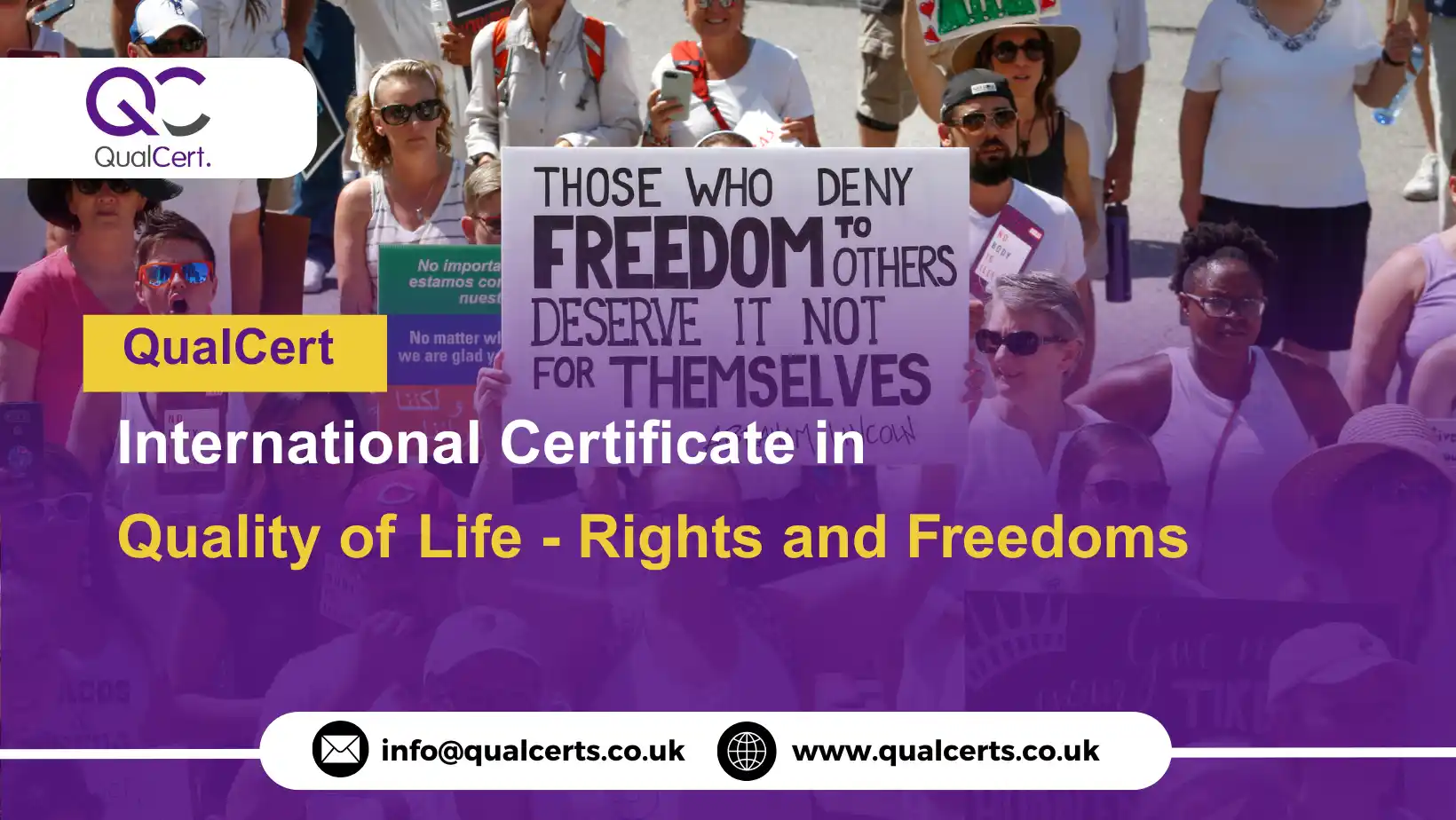
The QualCert International Certificate in Quality of Life – Rights and Freedoms is a globally recognised qualification designed to evaluate the essential factors that shape well being and social progress. At the heart of its framework are rights and freedoms, which determine how individuals experience dignity, equality, and security in their daily lives. By embedding civil liberties into its assessment, the certificate provides governments, organisations, and educational institutions with a structured approach to understanding how human rights influence quality of life across diverse societies.
This framework ensures that evaluations are balanced and comprehensive, highlighting disparities between communities and nations. It guides policymakers and researchers in identifying areas where investment in legal protections, inclusive policies, and civic engagement is most needed. The evidence generated supports policy development, strengthens international benchmarking, and enhances credibility by demonstrating commitment to holistic wellbeing.
The benefits of addressing rights and freedoms are far‑reaching: they promote equality, democratic participation, and sustainable development while reinforcing the connection between individual liberties and long‑term stability. In both developed and emerging economies, rights and freedoms serve as a cornerstone of wellbeing, reflecting justice, inclusion, and resilience. Ultimately, the certificate empowers societies to build fair, inclusive, and prosperous communities where people can thrive.
Program Framework
The QualCert International Certificate in Quality of Life – Rights and Freedoms , consist of 4 Credits, requiring a Total Qualification Time (TQT) of 40 hours, including 20 Guided Learning Hours (GLH). It is designed for efficient and focused skill development in Quality Control (QC).
| Units Ref# | Unit Title | Credit | GLH | TQT |
| QC01182- 1 | Principles of Rights and Freedoms in Quality of Life | 2 | 10 | 20 |
| QC01182-2 | Advanced Applications of Rights and Freedoms in Social and Organisational Contexts | 2 | 10 | 20 |
Entry Requirements
This course is designed to be inclusive, accessible, and professionally relevant for learners seeking to understand quality of life, human rights, and fundamental freedoms in personal, professional, and community settings. It is suitable for both new learners and experienced professionals.
- Minimum Age Requirement: Applicants must be at least 16 years old at the time of enrollment.
- Educational Background: A secondary school qualification or equivalent is recommended. Learners from backgrounds in social sciences, healthcare, education, community development, psychology, law, public policy, or related fields will benefit from this course.
- Professional Experience: No prior asset management experience is required, making this course ideal for entry-level learners. Basic awareness of human rights, social inclusion, equality, or community welfare is advantageous but not mandatory.
- Language Proficiency: Strong command of English (reading, writing, and speaking) is essential.
Core Achievements
Principles of Rights and Freedoms in Quality of Life
By the end of this unit, learners will be able to:
- Understand the concept of rights and freedoms and their role in enhancing quality of life.
- Explain how fundamental rights contribute to social justice, equality, and human dignity.
- Recognise the importance of international frameworks and conventions in protecting rights and freedoms.
- Identify barriers to the effective exercise of rights, such as discrimination or lack of awareness.
- Apply foundational methods to evaluate the protection and promotion of rights in different contexts.
- Analyse the impact of rights and freedoms on community wellbeing and organisational accountability.
Advanced Applications of Rights and Freedoms in Social and Organisational Contexts
By the end of this unit, learners will be able to:
- Implement advanced approaches to safeguarding rights and freedoms in social and organisational settings.
- Apply frameworks and tools to monitor, validate, and promote equality and justice.
- Evaluate risks associated with the denial or restriction of rights and freedoms.
- Integrate rights and freedoms management into organisational policies and community development strategies.
- Demonstrate practical skills in documenting, reporting, and advocating for rights and freedoms.
- Use case studies and industry examples to apply rights and freedoms principles in real‑world scenarios.
This course is designed for individuals and professionals who want to develop a strong understanding of quality of life, human rights, and fundamental rights and freedoms in diverse personal, professional, and community contexts. It is suitable for learners committed to promoting dignity, equality, inclusion, and rights-based practices.
• Healthcare and social care professionals supporting individuals, families, and communities
• Social workers, support workers, and caregivers involved in advocacy, wellbeing, and safeguarding
• Educators, trainers, and academic staff teaching or promoting human rights and social inclusion
• NGO, charity, and community organization staff working in rights-based and humanitarian settings
• Policy makers, administrators, and public service professionals engaged in social development and welfare
• Human rights advocates and equality practitioners seeking formal knowledge and professional recognition
• Students and early-career professionals aspiring to build careers in social justice, community development, or public services
This course provides a comprehensive foundation in quality of life, rights, and freedoms, enabling learners to apply ethical, inclusive, and rights-based approaches that enhance wellbeing and dignity across communities and professional environments.
Assessment and Verification
Assessment Framework :
The qualification is assessed through a structured Multiple-Choice Question (MCQ)–based examination, designed to measure both theoretical understanding and practical application of knowledge. Key features of the assessment framework include:
- Evidence-Based Assessment:
MCQs are developed using industry-aligned standards to ensure the assessment reflects real-world competencies and current professional practices. - Structured Examination Format:
The exam consists of scenario-based and knowledge-based MCQs, requiring learners to demonstrate critical thinking and subject mastery. - Performance Threshold:
Learners must obtain a minimum score of 70% to successfully complete the qualification. This benchmark ensures that every certified learner meets QualCert’s required level of competence. - Assessment Integrity:
All assessments are conducted under controlled, secure conditions at approved training centres to maintain fairness, consistency, and integrity.
Quality Assurance & Verification :
QualCert applies a comprehensive, multi-layered quality assurance system to uphold international standards and ensure the reliability of all assessment outcomes.
1. Internal Quality Assurance (IQA)
Conducted by the approved training centre:
- Assessment Review:
Centre-approved Assessors and Internal Quality Assurers (IQAs) review learner evidence, scoring accuracy, and compliance with assessment criteria. - Standardisation Activities:
Regular standardisation meetings are conducted within centres to ensure consistent marking practices across all assessors. - Continuous Improvement:
IQAs provide feedback to Assessors to enhance assessment delivery, marking reliability, and learner support.
2. External Quality Assurance (EQA)
Conducted by QualCert:
- Independent Verification:
QualCert External Quality Assurers review a sample of learner assessments to confirm accuracy, consistency, and compliance with QualCert and regulatory standards. - Centre Compliance Audits:
EQAs examine centre procedures, assessor qualifications, assessment environments, and record-keeping to ensure full adherence to quality assurance policies. - Quality and Standards Validation:
EQAs verify that assessment decisions are fair, valid, reliable, and aligned with national and international benchmarks. - Final Approval:
Once the EQA is satisfied that all quality standards have been met, the centre’s results are approved, and QualCert officially releases the certification to the learner.
QualCert delivers all qualifications exclusively through its global network of officially approved training centres.
For registration, guidance, or programme details, please contact your nearest approved training centre.