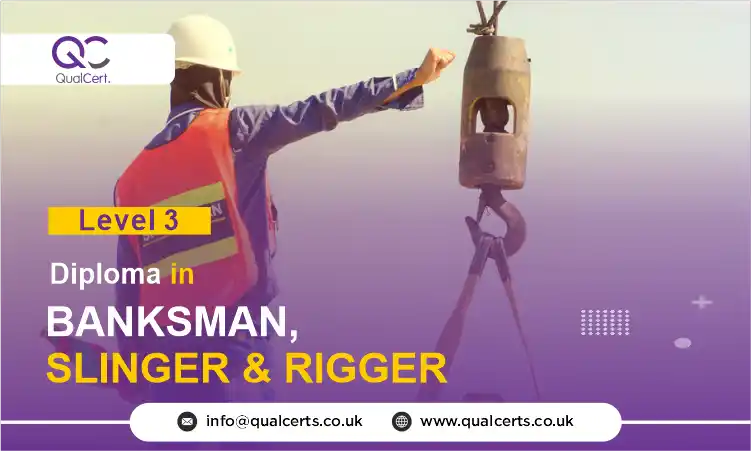
Master Banksman, Slinger & Rigger – QualCert Level 3 Diploma
The QualCert Combined Level 3 Diploma in Banksman, Slinger & Rigger Course is an advanced qualification designed for professionals seeking to develop expert-level skills in lifting operations, risk management, and leadership within the industry. This course follows UK international standards and ensures compliance with key regulations such as the Lifting Operations and Lifting Equipment Regulations (LOLER) 1998 and the Provision and Use of Work Equipment Regulations (PUWER) 1998.
This diploma provides in-depth knowledge of advanced lifting operations, load control dynamics, and specialised rigging techniques. Participants will learn how to conduct critical risk assessments, supervise lifting operations, and apply strategic problem-solving skills to complex lifting scenarios. The QualCert Combined Level 3 Diploma in Banksman, Slinger & Rigger Course is structured to combine theoretical learning with practical hands-on training, allowing learners to develop expertise in heavy lifting, equipment maintenance, and safety inspections.
The QualCert Combined Level 3 Diploma in Banksman, Slinger & Rigger Course is ideal for experienced banksmen, slingers, and riggers who want to progress into leadership roles. It equips candidates with the ability to oversee lifting teams, coordinate high-risk operations, and ensure compliance with UK health and safety regulations. Employers looking to train their workforce in advanced lifting operations can also benefit from enrolling their staff in this course to improve operational efficiency and workplace safety.
This qualification serves as a crucial stepping stone for those looking to advance their careers in construction, logistics, offshore operations, and other industries that require high-level expertise in lifting and rigging. The QualCert Combined Level 3 Diploma in Banksman, Slinger & Rigger Course prepares professionals for challenging roles, ensuring they are fully competent in handling complex lifting operations while maintaining the highest safety standards.
Program Framework
The QualCert Combined Level 3 Diploma in Banksman, Slinger & Rigger Course offers 60 Credits, requiring a Total Qualification Time (TQT) of 300 hours, including 210 Guided Learning Hours (GLH).The Level 3 Diploma is the highest level, designed for specialists, supervisors, and professionals managing complex lifting projects.
| Unit Ref# | Unit Title | Credit | GLH | TQT |
| QC13036-1 | Regulatory Frameworks and Global Industry Standards | 10 | 35 | 50 |
| QC13036-2 | Engineering Principles in Lifting Operations | 10 | 35 | 50 |
| QC13036-3 | High-Risk Lifting Operations and Heavy Load Handling | 10 | 35 | 50 |
| QC13036-4 | Leadership, Management, and Operational Planning | 10 | 35 | 50 |
| QC13036-5 | Advanced Equipment Inspection and Certification Processes | 10 | 35 | 50 |
| QC13036-6 | Specialized Case Studies and Real-World Applications | 10 | 35 | 50 |
Eligibility Criteria
To enrol in the QualCert Combined Level 3 Diploma in Banksman, Slinger & Rigger Course, candidates must meet the following entry requirements:
- Age Requirement – Candidates must be at least 18 years old.
- Educational Qualification – No formal qualifications are required, but a good understanding of English and mathematics is recommended for safety compliance and technical calculations.
- Language Proficiency – Candidates should have a sufficient level of English to understand course materials, safety instructions, and industry regulations.
- Physical Fitness – Candidates must be physically fit to perform lifting operations, manual handling, and work in challenging environments. A basic medical assessment may be required.
- Prior Knowledge or Experience – Completion of the Level 2 Diploma in Banksman, Slinger & Rigger or equivalent industry experience is strongly recommended. Candidates should have prior knowledge of lifting techniques, rigging equipment, and safety protocols.
These requirements ensure that candidates have the necessary foundation to successfully complete the course and apply advanced lifting and rigging skills in real-world operations.
Proficiency Targets
Regulatory Frameworks and Global Industry Standards
- Demonstrate a deep understanding of UK and international lifting regulations.
- Apply knowledge of LOLER 1998, PUWER 1998, and related safety laws.
- Implement compliance procedures for health, safety, and environmental standards.
- Ensure lifting operations meet global industry best practices.
- Maintain proper documentation and audit readiness for regulatory compliance.
Engineering Principles in Lifting Operations
- Analyse mechanical and structural principles affecting lifts.
- Understand load distribution, centre of gravity, and force calculations.
- Evaluate rigging configurations for safe load handling.
- Assess the suitability of lifting methods for different environments.
- Apply physics-based calculations to ensure operational efficiency and safety.
High-Risk Lifting Operations and Heavy Load Handling
- Identify and manage risks in complex lifting tasks.
- Plan operations involving oversized or heavy loads safely.
- Implement advanced lifting techniques like multi-crane or tandem lifts.
- Apply preventative measures for potential equipment or operational failures.
- Monitor environmental factors affecting high-risk lifting operations.
Leadership, Management, and Operational Planning
- Develop strategic planning skills for coordinated lifting projects.
- Supervise and manage teams effectively during lifting operations.
- Apply leadership techniques to enforce safety and compliance standards.
- Enhance communication for teamwork in high-pressure environments.
- Make informed operational decisions to ensure efficiency and safety.
Advanced Equipment Inspection and Certification Processes
- Conduct thorough inspections of lifting equipment.
- Ensure compliance with statutory inspection and certification requirements.
- Identify defects and implement maintenance procedures proactively.
- Recommend corrective actions to prevent equipment failure.
- Maintain operational safety through regular equipment audits.
Specialized Case Studies and Real-World Applications
- Analyse real-world lifting incidents to understand causes and effects.
- Develop problem-solving strategies for industry-specific challenges.
- Apply lessons learned to prevent accidents in future operations.
- Evaluate best practices for complex lifting environments.
- Implement practical solutions based on case study insights.
Ideal Participants
The QualCert Combined Level 3 Diploma in Banksman, Slinger & Rigger Course is specifically designed for professionals seeking to enhance their expertise in advanced lifting operations, rigging techniques, and safety management. This course is ideal for individuals who have prior experience in lifting operations and want to develop the necessary skills to take on supervisory or specialist roles within the industry. This qualification is suited for:
- Experienced Banksmen, Slingers, and Riggers – Professionals who have already gained foundational knowledge and experience in lifting operations and wish to advance their careers with a higher-level qualification.
- Supervisors and Team Leaders – Individuals responsible for overseeing lifting operations, ensuring compliance with UK safety regulations, and managing teams conducting lifting activities.
- Construction and Industrial Workers – Workers operating in sectors where heavy lifting and rigging are essential, including infrastructure projects, warehouses, and large-scale industrial sites.
- Offshore, Marine, and Oil & Gas Personnel – Those working in high-risk environments such as offshore platforms, shipyards, and energy plants where specialised lifting operations are required.
- Health and Safety Professionals – Individuals involved in safety inspections, risk assessments, and the enforcement of compliance regulations related to lifting operations.
- Employers and Organisations – Companies looking to improve their workforce’s expertise in lifting operations, ensuring adherence to LOLER 1998, PUWER 1998, and other UK health and safety regulations.
This course provides participants with the knowledge, technical ability, and leadership skills needed to execute and manage complex lifting operations safely and efficiently. It is an essential qualification for those looking to progress in their careers and take on more senior responsibilities in the industry.
Assessment and Verification
Assessment Framework :
This qualification consists of 6 mandatory assignments designed to assess the learner’s understanding and practical application of the required skills and knowledge. The key elements of the assessment framework include:
- Comprehensive Assignment Structure:
The assignments are designed to cover a range of topics within the qualification, ensuring that learners demonstrate their competence across all essential areas. - Pass Requirement:
Learners must successfully complete all 6 assignments to meet the requirements for certification. Each assignment must meet the specified criteria and demonstrate sufficient understanding and application of the subject matter. - Assessment Process:
Each assignment is reviewed and marked by a qualified assessor, with feedback provided to support learner development. - Final Completion Criteria:
The successful completion of all assignments is necessary for certification. Only learners who meet the required standards across all assignments will be awarded the qualification.
Quality Assurance & Verification:
QualCert applies a rigorous, multi-layered quality assurance system to ensure the reliability, consistency, and integrity of all assessments and results.
1. Internal Quality Assurance (IQA)
Conducted by the approved training centre:
- Assignment Evaluation:
Centre-approved Assessors and Internal Quality Assurers (IQAs) review the assignments to ensure they meet the assessment criteria and learning outcomes. - Standardisation:
Regular standardisation sessions are held to maintain consistency in assessment and marking practices across all centre staff. - Feedback & Support:
IQAs ensure that learners receive constructive feedback to aid their progress and improve future submissions.
2. External Quality Assurance (EQA)
Conducted by QualCert:
- Independent Verification:
QualCert’s External Quality Assurers (EQAs) verify the completed assignments and assess the quality and fairness of the marking process. - Centre Audits:
EQAs audit the centre’s compliance with QualCert’s quality assurance standards, reviewing assessment practices, learner records, and overall delivery. - Final Certification:
After satisfying the EQA’s verification process, QualCert will officially issue the certification to the learner.
QualCert delivers all qualifications exclusively through its network of officially approved training centres.
For registration or further information, please contact