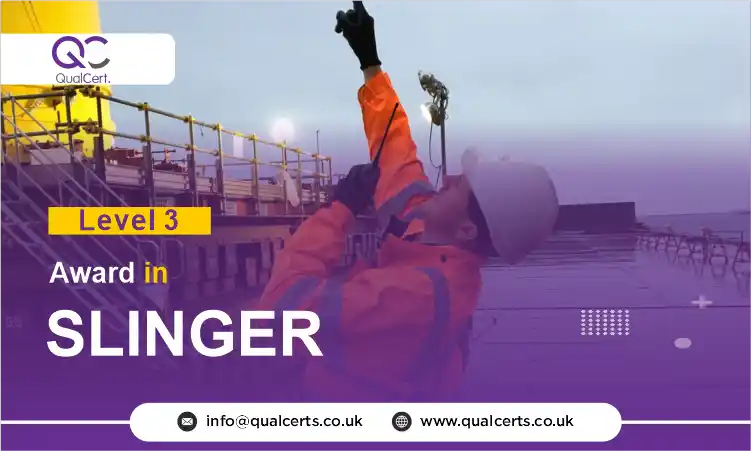
QualCert Slinger Level 3 Award – Professional Training
The QualCert Slinger Level 3 Award Course is a comprehensive training program designed for individuals who handle lifting operations in construction, industrial, and logistics environments. This award equips participants with the essential skills and knowledge to safely and efficiently sling, signal, and guide loads using lifting equipment such as cranes, hoists, and forklifts. The course is structured to meet industry standards and regulatory requirements, ensuring learners gain practical expertise in risk assessment, load calculations, and safe operational procedures.
Throughout the course, participants engage in a combination of theoretical learning and hands-on practical sessions. Topics covered include understanding lifting gear, selecting appropriate slings, securing loads, signaling techniques, and identifying potential hazards during lifting operations. The training emphasizes safety, precision, and compliance with industry best practices, preparing learners to confidently manage lifting tasks in real-world scenarios.
Upon completion, learners will be certified as competent Slinger Level 3 professionals, enhancing their employability and career prospects. This course is ideal for new entrants seeking a strong foundation in lifting operations as well as experienced operators aiming to formalize their skills. By gaining this qualification, participants contribute to safer workplaces, efficient lifting operations, and improved project outcomes across various sectors.
Program Framework
The QualCert Slinger Level 3 Award Course offers 6 Credits, including 18 Guided Learning Hours (GLH). This course provides foundational knowledge and essential skills in slinging operations, focusing on safety, load handling, and communication.
| Unit Ref# | Unit Title | Credit | GLH |
| QC13003–1 | Advanced Slinging Techniques and Load Securement | 1 | 3 |
| QC13003–2 | Compliance with International Lifting Standards | 1 | 3 |
| QC13003–3 | Lifting Gear Selection and Load Capacity Calculations | 1 | 3 |
| QC13003–4 | Site Safety, PPE, and Emergency Procedures | 1 | 3 |
| QC13003–5 | Role of a Slinger in Team-based Lifting Operations | 1 | 3 |
| QC13003–6 | Practical Assessment and Hands-on Training | 1 | 3 |
Eligibility Criteria
To enroll in the QualCert Slinger Level 3 Award Course, candidates must meet the following entry requirements:
- Minimum Age: Must be at least 18 years old
- Educational Background: No formal qualifications are required, but a good understanding of basic numeracy and literacy is recommended
- Prior Experience: Completion of the QualCert Slinger Level 2 Award or equivalent experience in lifting and slinging operations is highly recommended
- Language Proficiency: Ability to understand and communicate in the language of instruction (typically English)
These requirements ensure that candidates have the necessary foundation and capability to successfully engage with the advanced concepts and practical applications covered in this course.
Proficiency Targets
Advanced Slinging Techniques and Load Securement
- Apply advanced slinging techniques to ensure load stability and safe lifting.
- Determine the correct securing methods for irregular and heavy loads.
- Prevent load shifting, swinging, or tilting during lifting operations.
Compliance with International Lifting Standards
- Demonstrate understanding of UK and international lifting regulations, including LOLER and PUWER.
- Apply ISO and BS EN standards to ensure best practices in slinging operations.
- Conduct lifting tasks in compliance with legal and workplace safety requirements.
Lifting Gear Selection and Load Capacity Calculations
- Identify and select appropriate lifting gear, including slings, shackles, and spreader beams.
- Calculate safe working load limits (SWL) and lifting angles for different load types.
- Inspect lifting gear for wear, damage, and compliance with safety standards.
Site Safety, PPE, and Emergency Procedures
- Implement site safety protocols to minimize risks during lifting operations.
- Select and correctly use personal protective equipment (PPE) for lifting tasks.
- Respond effectively to emergency situations, including load failures and accidents.
Role of a Slinger in Team-Based Lifting Operations
- Communicate effectively with crane operators, riggers, and other lifting personnel.
- Understand the responsibilities of a slinger in coordinating safe lifting operations.
- Assist in planning and executing complex lifts as part of a team.
Practical Assessment and Hands-on Training
- Demonstrate proper sling selection, attachment, and load handling techniques.
- Apply risk assessment procedures in real-world lifting scenarios.
- Execute safe and efficient lifting operations under supervised practical conditions.
These learning outcomes ensure that participants gain both theoretical knowledge and practical expertise to perform slinging operations safely and effectively in compliance with industry standards.
Ideal Participants
The QualCert Level 3 Award in Slinger Operations is designed for professionals who are involved in lifting and slinging tasks across various industries. It is ideal for individuals looking to enhance their expertise in advanced load handling, risk assessment, and compliance with UK and international lifting standards.
This course is suitable for:
- Experienced Slingers and Riggers who want to develop advanced skills in complex lifting operations.
- Crane Operators and Lifting Supervisors responsible for coordinating and executing safe lifting tasks.
- Construction and Engineering Professionals involved in heavy lifting and rigging activities.
- Health and Safety Officers overseeing lifting operations to ensure compliance with regulations such as LOLER and PUWER.
- Logistics and Warehouse Personnel managing the secure lifting, movement, and placement of loads.
- Oil, Gas, and Marine Industry Workers handling high-risk lifting operations in offshore and industrial environments.
The QualCert Slinger Level 3 Award Course is particularly beneficial for those aiming to take on leadership roles in lifting operations, improve workplace safety, and ensure efficient load handling in challenging environments.
Assessment and Verification
Assessment Framework :
The qualification is assessed through a structured Multiple-Choice Question (MCQ)–based examination, designed to measure both theoretical understanding and practical application of knowledge. Key features of the assessment framework include:
- Evidence-Based Assessment:
MCQs are developed using industry-aligned standards to ensure the assessment reflects real-world competencies and current professional practices. - Structured Examination Format:
The exam consists of scenario-based and knowledge-based MCQs, requiring learners to demonstrate critical thinking and subject mastery. - Performance Threshold:
Learners must obtain a minimum score of 70% to successfully complete the qualification. This benchmark ensures that every certified learner meets QualCert’s required level of competence. - Assessment Integrity:
All assessments are conducted under controlled, secure conditions at approved training centres to maintain fairness, consistency, and integrity.
Quality Assurance & Verification :
QualCert applies a comprehensive, multi-layered quality assurance system to uphold international standards and ensure the reliability of all assessment outcomes.
1. Internal Quality Assurance (IQA)
Conducted by the approved training centre:
- Assessment Review:
Centre-approved Assessors and Internal Quality Assurers (IQAs) review learner evidence, scoring accuracy, and compliance with assessment criteria. - Standardisation Activities:
Regular standardisation meetings are conducted within centres to ensure consistent marking practices across all assessors. - Continuous Improvement:
IQAs provide feedback to Assessors to enhance assessment delivery, marking reliability, and learner support.
2. External Quality Assurance (EQA)
Conducted by QualCert:
- Independent Verification:
QualCert External Quality Assurers review a sample of learner assessments to confirm accuracy, consistency, and compliance with QualCert and regulatory standards. - Centre Compliance Audits:
EQAs examine centre procedures, assessor qualifications, assessment environments, and record-keeping to ensure full adherence to quality assurance policies. - Quality and Standards Validation:
EQAs verify that assessment decisions are fair, valid, reliable, and aligned with national and international benchmarks. - Final Approval:
Once the EQA is satisfied that all quality standards have been met, the centre’s results are approved, and QualCert officially releases the certification to the learner.
QualCert delivers all qualifications exclusively through its global network of officially approved training centres.
For registration, guidance, or programme details, please contact your nearest approved training centre.