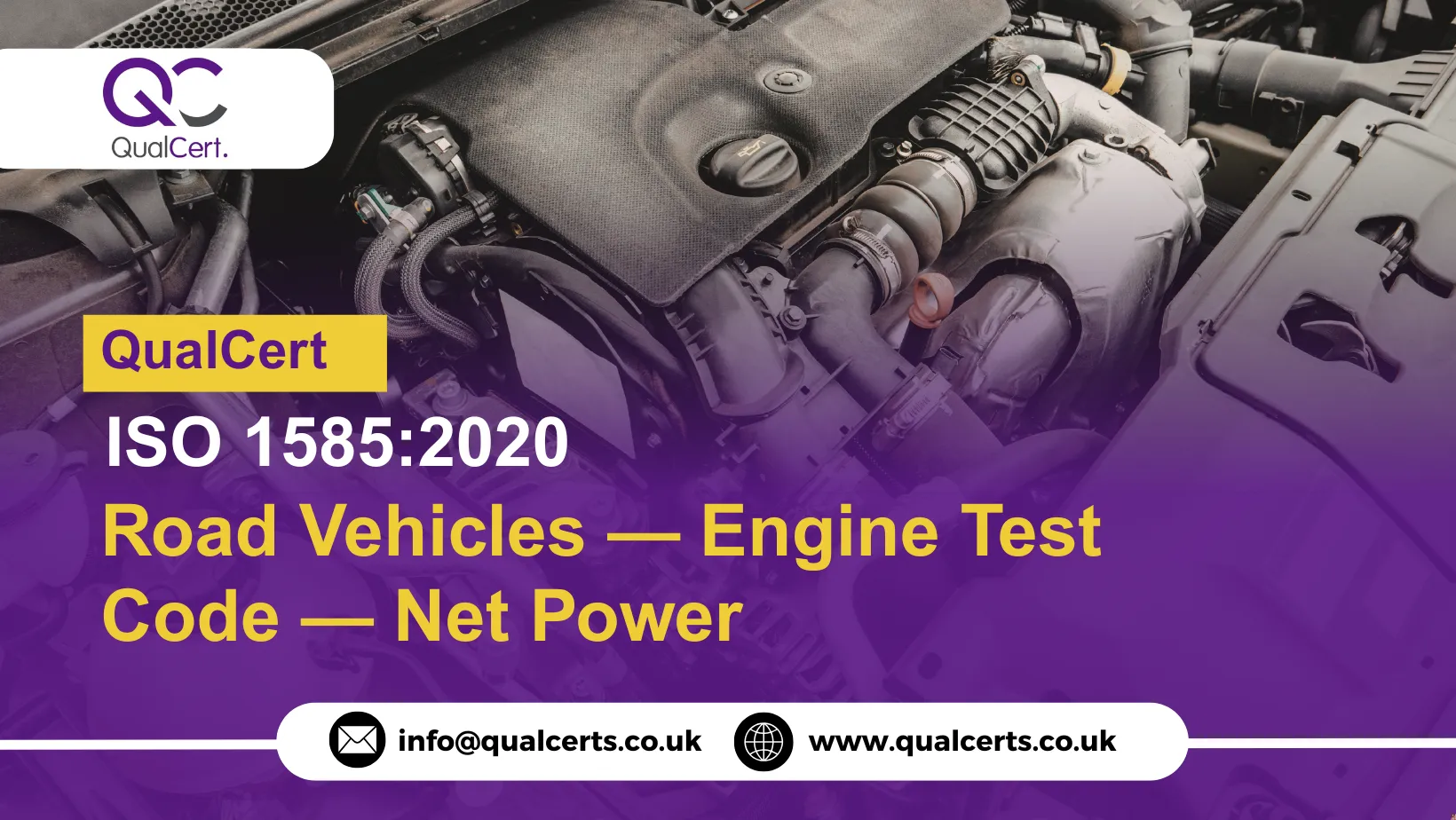
ISO 1585:2020 Road Vehicle Engine Net Power
ISO 1585:2020, published by the International Organization for Standardization (ISO), is a comprehensive engine test code that sets forth the procedures and conditions for determining the net power output of internal combustion engines used in road vehicles. Essentially, QualCert ISO 1585:2020 Road Vehicles — Engine Test Code — Net Power provides a standardized framework for measuring the true power delivered by an engine, accounting for losses due to auxiliary components like the water pump and generator.
The net power of an engine refers to the power output at the engine’s flywheel after accounting for losses due to auxiliary components such as the water pump, generator, and other accessories necessary for the engine’s operation. QualCert ISO 1585:2020 Road Vehicles — Engine Test Code — Net Power provides an accurate representation of the engine’s performance under real-world operating conditions.
ISO 1585:2020 is more than just a set of guidelines—it’s a cornerstone of engine testing in the automotive industry. By providing a standardized method for measuring net power output, this standard ensures accuracy, reliability, and fairness in the assessment of engine performance. From regulatory compliance to consumer confidence, ISO 1585 plays a vital role in shaping the future of road vehicles, unlocking the power that drives us forward.
Program Framework
The QualCert ISO 1585:2020 Road Vehicles — Engine Test Code — Net Power is a 30-credit qualification with a Total Qualification Time (TQT) of 180 hours, including 120 Guided Learning Hours (GLH). This program is meticulously crafted to deliver focused and efficient skill development in the field.
| Unit Ref# | Unit Title | Credits | GLH | TQT |
| QC04003 – 1 | Introduction to Engine Testing Standards | 5 | 20 | 30 |
| QC04003 – 2 | Test Procedures and Measurement Techniques | 5 | 20 | 30 |
| QC04003 – 3 | Power and Performance Analysis in Vehicles | 5 | 20 | 30 |
| QC04003 – 4 | Emission Control and Compliance Testing | 5 | 20 | 30 |
| QC04003 – 5 | Quality Assurance in Engine Performance Testing | 5 | 20 | 30 |
| QC04003 – 6 | Advanced Data Acquisition and Interpretation in Engine Testing | 5 | 20 | 30 |
Eligibility Criteria
The QualCert ISO 1585:2020 Road Vehicles — Engine Test Code — Net Power course is designed for professionals involved in engine testing, performance evaluation, and compliance with international automotive standards. The entry requirements for this course are as follows:
- Minimum Age: Applicants must be at least 18 years old to enroll in this professional training.
- Educational Background: A high school diploma or equivalent is required. Preference is given to candidates with backgrounds in automotive engineering, mechanical engineering, or related technical fields.
- Experience: Prior exposure to road vehicle testing, automotive systems, or laboratory procedures is recommended.
- Language Proficiency: Strong command of English in reading, writing, and speaking is essential to understand ISO standards, technical documentation, and testing procedures.
Core Achievements
1. Introduction to Engine Testing Standards
By the end of this unit, learners will be able to:
- Understand the purpose and scope of ISO 1585:2020 for engine power measurement.
- Explain the evolution and significance of international engine testing standards.
- Identify different types of engine tests (net power, gross power, brake power) and when they are applied.
- Interpret key terminologies used in engine test protocols and documentation.
2. Test Procedures and Measurement Techniques
By the end of this unit, learners will be able to:
- Outline standard engine test procedures as per ISO 1585:2020.
- Set up a controlled test environment using appropriate instrumentation and sensors.
- Measure key engine parameters such as torque, RPM, and fuel flow accurately.
- Understand the influence of ambient conditions (temperature, pressure, humidity) on test results and apply necessary correction factors.
3. Power and Performance Analysis in Vehicles
By the end of this unit, learners will be able to:
- Calculate engine net power output and analyze performance curves.
- Interpret power vs. torque graphs and efficiency maps for internal combustion engines.
- Compare theoretical vs. actual performance data under different load conditions.
- Relate engine performance metrics to real-world vehicle dynamics and applications.
4. Emission Control and Compliance Testing
By the end of this unit, learners will be able to:
- Identify major engine emissions (CO, NOx, HC, PM) and their environmental impacts.
- Conduct standard emission tests using regulated methods and equipment.
- Understand the role of after-treatment systems and emission reduction technologies.
- Ensure compliance with international and regional emission standards (e.g., Euro 6, EPA Tier standards).
5. Quality Assurance in Engine Performance Testing
By the end of this unit, learners will be able to:
- Apply quality assurance protocols to ensure repeatability and accuracy in engine tests.
- Calibrate equipment and verify data integrity in line with ISO and laboratory standards.
- Implement audit trails, traceability measures, and testing certifications.
- Prepare compliant technical documentation and test reports for quality audits.
6. Advanced Data Acquisition and Interpretation in Engine Testing
By the end of this unit, learners will be able to:
- Set up advanced data acquisition systems for high-resolution engine testing.
- Collect, filter, and process real-time test data using software tools.
- Analyze and interpret large datasets to identify performance trends and anomalies.
- Present insights in structured test reports for engineering and regulatory review.
Learner Suitability
The QualCert ISO 1585:2020 Road Vehicle Engine Test course is designed for professionals and learners who want to deepen their expertise in automotive testing, compliance, and performance measurement. It is ideal for those aiming to ensure road vehicles meet international ISO standards for net engine power.
- Automotive Engineers: Professionals involved in vehicle design, development, and performance testing.
- Quality Assurance Specialists: Ensuring compliance with ISO 1585:2020 standards in automotive manufacturing.
- Laboratory Technicians: Conducting engine test code procedures and analyzing net power results.
- R&D Professionals: Developing new vehicle technologies and validating performance through standardized testing.
- Compliance Officers: Monitoring adherence to ISO standards in automotive production and testing facilities.
- Students & Graduates: From mechanical engineering, automotive engineering, or related technical fields seeking industry‑recognized training.
By completing this course, participants will gain the technical knowledge and confidence to apply ISO 1585:2020 engine test code procedures effectively, ensuring vehicles meet global performance and compliance standards.
Assessment and Verification
Assessment Framework :
This qualification consists of 6 mandatory assignments designed to assess the learner’s understanding and practical application of the required skills and knowledge. The key elements of the assessment framework include:
- Comprehensive Assignment Structure:
The assignments are designed to cover a range of topics within the qualification, ensuring that learners demonstrate their competence across all essential areas. - Pass Requirement:
Learners must successfully complete all 6 assignments to meet the requirements for certification. Each assignment must meet the specified criteria and demonstrate sufficient understanding and application of the subject matter. - Assessment Process:
Each assignment is reviewed and marked by a qualified assessor, with feedback provided to support learner development. - Final Completion Criteria:
The successful completion of all assignments is necessary for certification. Only learners who meet the required standards across all assignments will be awarded the qualification.
Quality Assurance & Verification:
QualCert applies a rigorous, multi-layered quality assurance system to ensure the reliability, consistency, and integrity of all assessments and results.
1. Internal Quality Assurance (IQA)
Conducted by the approved training centre:
- Assignment Evaluation:
Centre-approved Assessors and Internal Quality Assurers (IQAs) review the assignments to ensure they meet the assessment criteria and learning outcomes. - Standardisation:
Regular standardisation sessions are held to maintain consistency in assessment and marking practices across all centre staff. - Feedback & Support:
IQAs ensure that learners receive constructive feedback to aid their progress and improve future submissions.
2. External Quality Assurance (EQA)
Conducted by QualCert:
- Independent Verification:
QualCert’s External Quality Assurers (EQAs) verify the completed assignments and assess the quality and fairness of the marking process. - Centre Audits:
EQAs audit the centre’s compliance with QualCert’s quality assurance standards, reviewing assessment practices, learner records, and overall delivery. - Final Certification:
After satisfying the EQA’s verification process, QualCert will officially issue the certification to the learner.
QualCert delivers all qualifications exclusively through its network of officially approved training centres.
For registration or further information, please contact your nearest approved training centre.