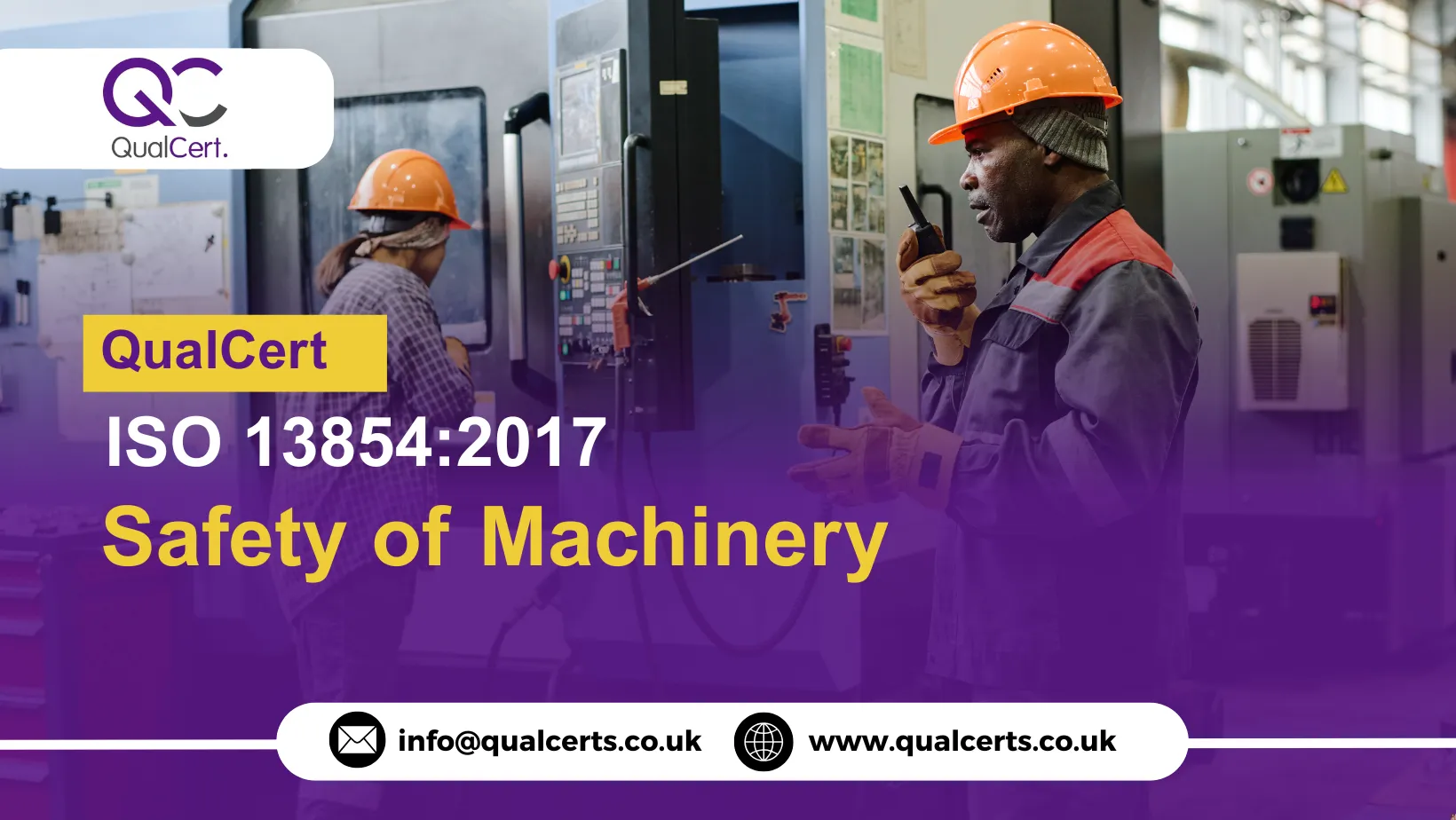
QualCert ISO 13854:2017 Safety of Machinery Course
In today’s industrial landscape, ensuring the safety of operators and personnel is paramount. Machinery and equipment used in various industries pose inherent risks, particularly the potential for crushing hazards that could result in severe injuries or even fatalities. To address this critical safety concern, international standards such as QualCert ISO 13854:2017 Safety of Machinery have been established to provide guidelines for preventing crushing of human body parts by machinery.
ISO 13854:2017, titled “Safety of machinery – Minimum gaps to avoid crushing of parts of the human body,” sets out requirements and recommendations for determining minimum gaps to prevent crushing hazards between moving parts of machinery and human body parts. The standard aims to minimize the risk of accidents and injuries by establishing clear guidelines for machinery design and operation.
QualCert ISO 13854:2017 Safety of Machinery plays a crucial role in promoting the safety of machinery by providing guidelines for determining minimum gaps to prevent crushing hazards. By adhering to the principles outlined in this standard and implementing appropriate minimum gap requirements, manufacturers and users can effectively mitigate the risk of injuries and create safer working environments for personnel. Let’s prioritize machinery safety and work together to ensure compliance with ISO 13854:2017 and other relevant standards in our workplaces.
Program Framework
The QualCert ISO 13854:2017 Safety of Machinery is a 30-credit qualification with a Total Qualification Time (TQT) of 180 hours, including 120 Guided Learning Hours (GLH). This program is meticulously crafted to deliver focused and efficient skill development in the field.
| Unit Ref# | Unit Title | Credits | GLH | TQT |
| QC04007 – 1 | Fundamentals of Machinery Safety Regulations | 5 | 20 | 30 |
| QC04007 – 2 | Safe Design Principles and Risk Reduction | 5 | 20 | 30 |
| QC04007 – 3 | Protective Equipment and Guarding Systems | 5 | 20 | 30 |
| QC04007 – 4 | Verification and Validation of Safety Features | 5 | 20 | 30 |
| QC04007 – 5 | International Compliance Requirements for Machinery | 5 | 20 | 30 |
| QC04007 – 6 | Maintenance and Management of Machinery Safety Systems | 5 | 20 | 30 |
Eligibility Criteria
To enrol in the QualCert ISO 13854:2017 Safety of Machinery course, candidates must meet the following entry requirements:
- Minimum Age: Learners must be at least 18 years old at the time of enrollment.
- Educational Background: A secondary school qualification or equivalent is required. Prior study in engineering, manufacturing, or technical subjects is recommended.
- Work Experience: No formal work experience is mandatory; however, exposure to machinery operation, industrial safety, or technical workshops is highly beneficial.
- Language Proficiency: Applicants must demonstrate English proficiency to understand technical standards, safety documentation, and assessments.
Core Achievements
1. Fundamentals of Machinery Safety Regulations
By the end of this unit, learners will be able to:
- Explain key machinery safety regulations and their legal implications.
- Identify responsibilities of manufacturers, employers, and operators under safety laws.
- Understand the role of regulatory bodies and enforcement mechanisms.
- Interpret relevant safety documentation and standards applicable to machinery.
2. Safe Design Principles and Risk Reduction
By the end of this unit, learners will be able to:
- Apply fundamental principles of safe machinery design to minimize hazards.
- Conduct risk assessments to identify and reduce potential machinery hazards.
- Integrate engineering controls and fail-safe design elements into machinery.
- Balance safety with functionality and operational efficiency in design decisions.
3. Protective Equipment and Guarding Systems
By the end of this unit, learners will be able to:
- Identify various types of protective equipment and guarding systems for machinery safety.
- Understand selection criteria and proper application of guards and safety devices.
- Evaluate the effectiveness of guarding systems in preventing accidents.
- Ensure compliance with design and installation standards for protective equipment.
4. Verification and Validation of Safety Feature
By the end of this unit, learners will be able to:
- Develop procedures for verifying and validating machinery safety features.
- Use inspection, testing, and audit techniques to confirm safety system performance.
- Document verification and validation activities to demonstrate compliance.
- Identify and address non-conformities or failures in safety features.
5. International Compliance Requirements for Machinery
By the end of this unit, learners will be able to:
- Identify key international standards and regulations governing machinery safety.
- Understand how to apply global compliance requirements in different jurisdictions.
- Prepare machinery and documentation for international market entry and certification.
- Monitor updates and changes in international safety standards.
6. Maintenance and Management of Machinery Safety Systems
By the end of this unit, learners will be able to:
- Design and implement maintenance programs for machinery safety systems.
- Identify common maintenance issues that affect safety and operational integrity.
- Manage safety system maintenance schedules and record-keeping.
- Promote a culture of safety through effective management and continuous improvement.
Learner Suitability
The QualCert ISO 13854:2017 Safety of Machinery course is designed for professionals and organizations committed to preventing crushing hazards in machinery. It provides essential knowledge on minimum gaps and clearances to ensure safe machine design and operation.
- Engineers and designers: Ideal for mechanical, electrical, and industrial engineers involved in machinery design. It helps them integrate ISO 13854 safety standards into their projects.
- Health and safety professionals: Perfect for those responsible for workplace safety and compliance. It equips them with the tools to identify hazards and implement effective safety measures.
- Manufacturing and production staff: Beneficial for supervisors, technicians, and operators working with machinery daily. It enhances their understanding of safe practices and compliance requirements.
- Compliance officers and auditors: Suitable for professionals overseeing regulatory compliance and safety audits. It provides a recognized framework for evaluating machinery safety systems.
- Vocational learners and career changers: Accessible to individuals seeking to enter the safety or engineering field. It offers a structured pathway into machinery safety management.
In summary, this course is for anyone involved in designing, operating, or managing machinery who wants to ensure compliance with ISO 13854:2017 standards. Whether you are an engineer, safety officer, or industry professional, the program equips you with the expertise to safeguard people, processes, and equipment by applying minimum gap requirements to avoid crushing hazards.
Asessment and Verification
Assessment Framework :
This qualification consists of 6 mandatory assignments designed to assess the learner’s understanding and practical application of the required skills and knowledge. The key elements of the assessment framework include:
- Comprehensive Assignment Structure:
The assignments are designed to cover a range of topics within the qualification, ensuring that learners demonstrate their competence across all essential areas. - Pass Requirement:
Learners must successfully complete all 6 assignments to meet the requirements for certification. Each assignment must meet the specified criteria and demonstrate sufficient understanding and application of the subject matter. - Assessment Process:
Each assignment is reviewed and marked by a qualified assessor, with feedback provided to support learner development. - Final Completion Criteria:
The successful completion of all assignments is necessary for certification. Only learners who meet the required standards across all assignments will be awarded the qualification.
Quality Assurance & Verification:
QualCert applies a rigorous, multi-layered quality assurance system to ensure the reliability, consistency, and integrity of all assessments and results.
1. Internal Quality Assurance (IQA)
Conducted by the approved training centre:
- Assignment Evaluation:
Centre-approved Assessors and Internal Quality Assurers (IQAs) review the assignments to ensure they meet the assessment criteria and learning outcomes. - Standardisation:
Regular standardisation sessions are held to maintain consistency in assessment and marking practices across all centre staff. - Feedback & Support:
IQAs ensure that learners receive constructive feedback to aid their progress and improve future submissions.
2. External Quality Assurance (EQA)
Conducted by QualCert:
- Independent Verification:
QualCert’s External Quality Assurers (EQAs) verify the completed assignments and assess the quality and fairness of the marking process. - Centre Audits:
EQAs audit the centre’s compliance with QualCert’s quality assurance standards, reviewing assessment practices, learner records, and overall delivery. - Final Certification:
After satisfying the EQA’s verification process, QualCert will officially issue the certification to the learner.
QualCert delivers all qualifications exclusively through its network of officially approved training centres.
For registration or further information, please contact your nearest approved training centre.