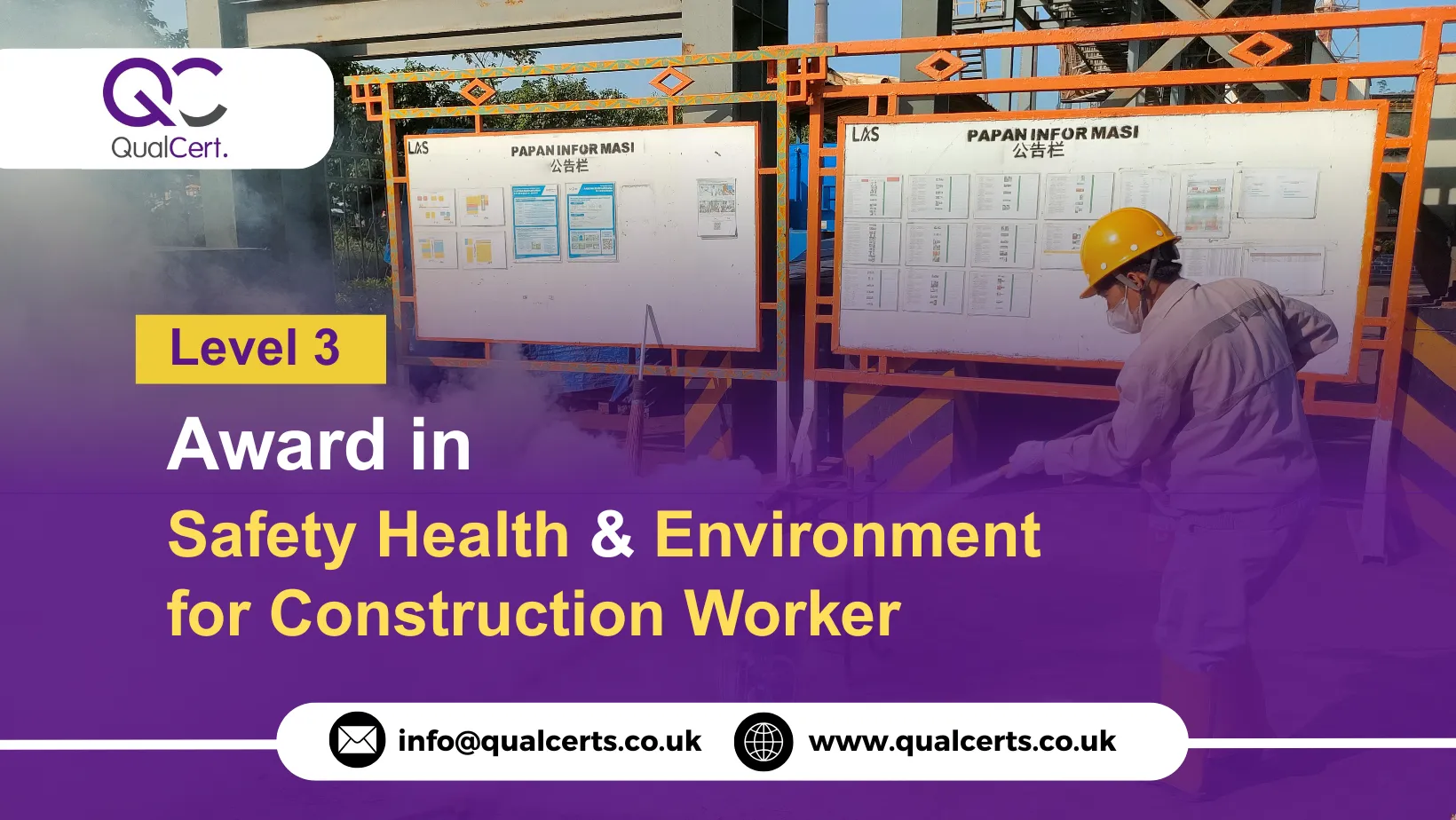
Safety Health and Environment for Construction Worker Success
The QualCert Level 3 Award in Safety Health and Environment for Construction Worker is a professional qualification designed to strengthen workplace safety standards and promote responsible practices across construction sites. With construction being one of the most high-risk industries, effective management of health, safety, and environmental responsibilities is essential for both compliance and worker wellbeing.
This award focuses on practical approaches to Safety Health and Environment for Construction Worker, equipping learners with the skills to identify hazards, implement preventative measures, and foster a culture of safety. Participants gain knowledge in risk assessment, environmental protection, and health management, ensuring that construction projects meet industry regulations while safeguarding employees and communities.
Whether you are a site supervisor, team leader, or aspiring professional in the construction sector, the QualCert Level 3 Award in Safety Health and Environment for Construction Worker provides the confidence and expertise to lead responsibly, reduce risks, and contribute to sustainable workplace practices.
Program Framework
The QualCert Level 3 Award in Safety Health and Environment for Construction Worker certification is designed to provide a structured and comprehensive framework for developing expertise in health and safety. Below is the qualification structure, including the Total Qualification Time (TQT) 30, Guided Learning Hours (GLH) 18, and 6 Credits associated with the program.
| Unit Ref# | Unit Title | Credits | GLH | TQT |
| QC08002 – 1 | Introduction to Health and Safety in Construction | 1 | 3 | 5 |
| QC08002 – 2 | Common Workplace Hazards and Controls | 1 | 3 | 5 |
| QC08002 – 3 | Safe Use of Tools, Equipment, and PPE | 1 | 3 | 5 |
| QC08002 – 4 | Working at Heights, Manual Handling, and Confined Spaces | 1 | 3 | 5 |
| QC08002 – 5 | Environmental Awareness and Waste Management | 1 | 3 | 5 |
| QC08002 – 6 | Fire Safety and Emergency Procedures | 1 | 3 | 5 |
Eligibility Criteria
To enroll in the QualCert Level 3 Award in Safety Health and Environment for Construction Worker, learners must meet certain entry requirements. These criteria ensure participants are prepared to engage with the training and apply health, safety, and environmental principles effectively in construction settings.
- Minimum Age: Learners must be at least 18 years old.
- Educational Background: No formal academic qualifications are required, though a basic understanding of workplace practices is recommended.
- Work Experience: Prior experience in construction, supervision, or health and safety roles is helpful but not mandatory.
- Professional Experience: Best suited for construction workers, site supervisors, and team leaders aiming to strengthen safety and environmental practices.
- Language Proficiency: A good command of English is essential to understand course materials, participate in discussions, and complete assessments successfully.
Meeting these requirements ensures that learners can fully benefit from the QualCert Level 3 Award in Safety Health and Environment for Construction Worker. With accessible criteria, the qualification is open to professionals at different career stages who want to enhance their skills while promoting safer and more sustainable construction environments.
Proficiency Targets
Introduction to Health and Safety in Construction
- Understand the legal and regulatory framework governing health and safety in construction.
- Identify the roles and responsibilities of both workers and employers in maintaining a safe work environment.
- Recognize the importance of health and safety policies in preventing accidents and reducing risks.
- Understand the procedures for reporting hazards and incidents on construction sites.
- Apply health and safety knowledge to promote a culture of safety in the workplace.
Common Workplace Hazards and Controls
- Identify common workplace hazards on construction sites, including electrical, mechanical, chemical, and physical risks.
- Evaluate potential risks associated with different construction activities.
- Implement control measures to mitigate identified hazards effectively.
- Conduct basic risk assessments and recommend appropriate safety actions.
- Promote hazard awareness among team members to reduce workplace incidents.
Safe Use of Tools, Equipment, and PPE
- Demonstrate proper selection, maintenance, and usage of construction tools and equipment.
- Understand the role of personal protective equipment (PPE) in injury prevention.
- Inspect and maintain PPE to ensure it is safe and effective.
- Apply correct procedures when using tools, machinery, and PPE.
- Promote safe working practices related to equipment and PPE among colleagues.
Working at Heights, Manual Handling, and Confined Spaces
- Understand the risks associated with working at heights and implement safety precautions.
- Apply safe manual handling techniques to prevent musculoskeletal injuries.
- Identify hazards in confined spaces and implement appropriate safety measures.
- Plan and carry out tasks in high-risk environments safely.
- Educate and supervise others in safe practices for heights, manual handling, and confined spaces.
Environmental Awareness and Waste Management
- Understand the environmental impact of construction activities and the importance of sustainable practices.
- Implement effective strategies for managing construction waste and minimizing environmental damage.
- Promote recycling, reuse, and responsible disposal of construction materials.
- Assess and reduce the environmental footprint of construction operations.
- Encourage sustainable practices among teams and stakeholders on-site.
Fire Safety and Emergency Procedures
- Identify fire hazards commonly found on construction sites and implement preventive measures.
- Develop and follow emergency response plans for fires and other incidents.
- Demonstrate knowledge of evacuation procedures and firefighting techniques.
- Understand the responsibilities of workers during emergencies to maintain safety.
- Promote a proactive safety culture by preparing for and responding effectively to emergencies.
Ideal Participants
The QualCert Level 3 Award in Safety Health and Environment for Construction Worker is designed for professionals who want to strengthen workplace safety, health, and environmental practices. This qualification is suitable for individuals across the construction industry who hold responsibility for guiding teams, managing risks, and ensuring compliance with safety standards.
- Construction Workers: Those directly involved in site activities who want to improve their knowledge of health, safety, and environmental responsibilities.
- Site Supervisors and Team Leaders: Individuals overseeing daily operations who aim to promote safe and sustainable practices on construction sites.
- Health and Safety Officers: Professionals seeking to expand their expertise into construction-specific safety and environmental management.
- Compliance and Risk Management Staff: Employees tasked with audits, reporting, and ensuring adherence to workplace safety regulations.
- Career Builders: Learners looking to enhance their CV with a recognized qualification in safety, health, and environment for construction.
- Employees in High-Risk Roles: Workers in demolition, heavy machinery, or hazardous environments where safety and environmental awareness is critical.
This award is accessible to professionals at all career stages, from entry-level workers to experienced supervisors. By completing the QualCert Level 3 Award in Safety Health and Environment for Construction Worker, learners gain the skills to reduce risks, protect the environment, and foster a culture of safety across construction projects.
Assessment and Verification
Assessment Framework :
The qualification is assessed through a structured Multiple-Choice Question (MCQ)–based examination, designed to measure both theoretical understanding and practical application of knowledge. Key features of the assessment framework include:
- Evidence-Based Assessment:
MCQs are developed using industry-aligned standards to ensure the assessment reflects real-world competencies and current professional practices. - Structured Examination Format:
The exam consists of scenario-based and knowledge-based MCQs, requiring learners to demonstrate critical thinking and subject mastery. - Performance Threshold:
Learners must obtain a minimum score of 70% to successfully complete the qualification. This benchmark ensures that every certified learner meets QualCert’s required level of competence. - Assessment Integrity:
All assessments are conducted under controlled, secure conditions at approved training centres to maintain fairness, consistency, and integrity.
Quality Assurance & Verification :
QualCert applies a comprehensive, multi-layered quality assurance system to uphold international standards and ensure the reliability of all assessment outcomes.
1. Internal Quality Assurance (IQA)
Conducted by the approved training centre:
- Assessment Review:
Centre-approved Assessors and Internal Quality Assurers (IQAs) review learner evidence, scoring accuracy, and compliance with assessment criteria. - Standardisation Activities:
Regular standardisation meetings are conducted within centres to ensure consistent marking practices across all assessors. - Continuous Improvement:
IQAs provide feedback to Assessors to enhance assessment delivery, marking reliability, and learner support.
2. External Quality Assurance (EQA)
Conducted by QualCert:
- Independent Verification:
QualCert External Quality Assurers review a sample of learner assessments to confirm accuracy, consistency, and compliance with QualCert and regulatory standards. - Centre Compliance Audits:
EQAs examine centre procedures, assessor qualifications, assessment environments, and record-keeping to ensure full adherence to quality assurance policies. - Quality and Standards Validation:
EQAs verify that assessment decisions are fair, valid, reliable, and aligned with national and international benchmarks. - Final Approval:
Once the EQA is satisfied that all quality standards have been met, the centre’s results are approved, and QualCert officially releases the certification to the learner.
QualCert delivers all qualifications exclusively through its global network of officially approved training centres.
For registration, guidance, or programme details, please contact your nearest approved training centre.