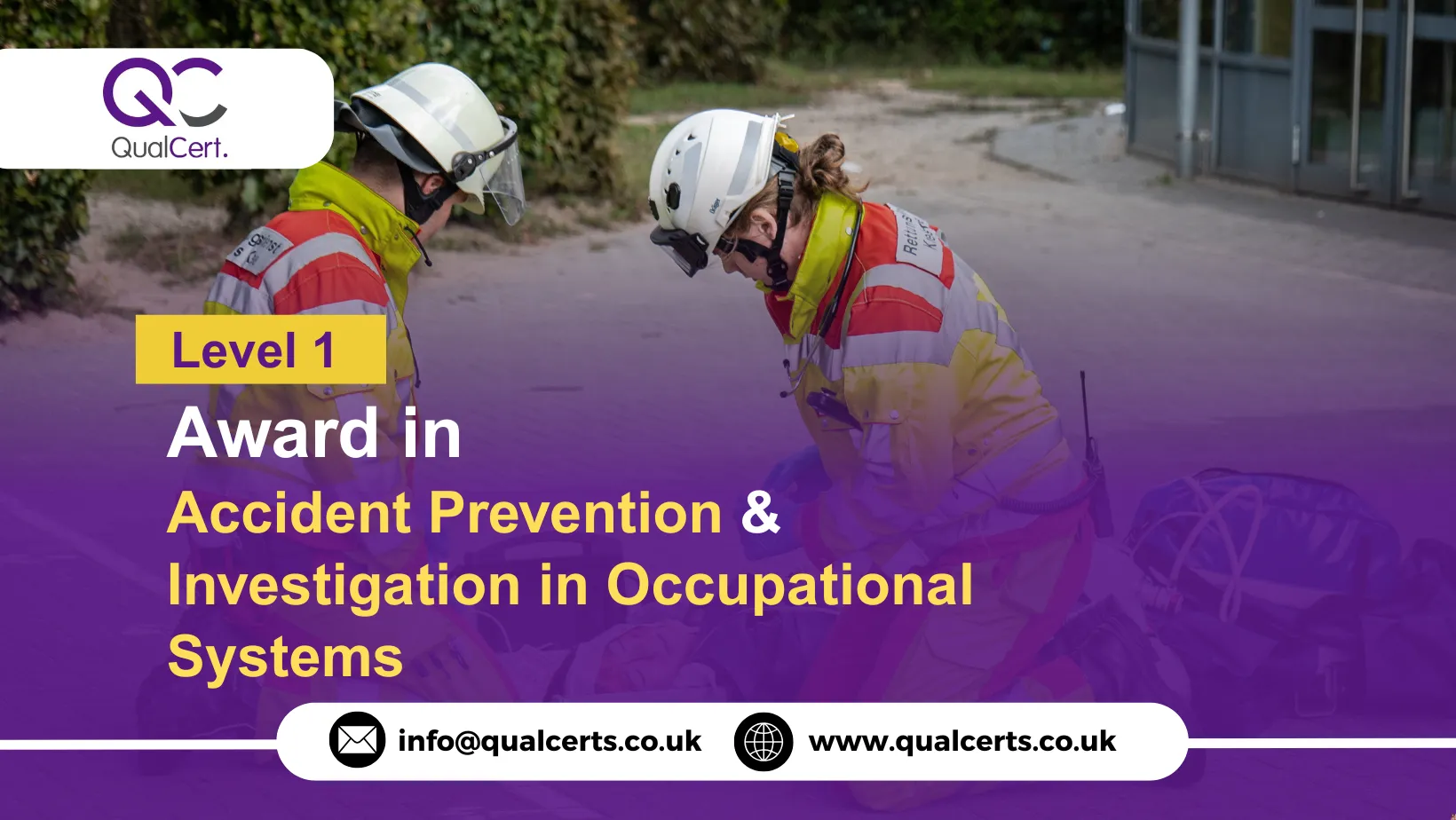
QualCert L1 Award: Proven Accident Prevention & Investigation
The QualCert Level 1 Award in Accident Prevention and Investigation in Occupational Systems introduces the essential principles of workplace safety, hazard prevention, and basic investigation techniques. Designed for workers, team leaders, and supervisors, this qualification provides a solid foundation for identifying risks and preventing incidents in occupational environments.
Learners will explore key topics such as hazard identification, risk assessment, and incident reporting, all of which form the backbone of effective safety management. The program emphasizes proactive safety culture, aligning with international standards to ensure participants gain globally recognized skills. Through interactive learning and practical examples, candidates develop the ability to recognize hazards and take preventive measures before accidents occur.
Delivered over two days, the course consists of three study units. These cover workplace hazards and risk management, accident reporting procedures, and the fundamentals of accident investigation. By completing this qualification, participants will be equipped to contribute actively to workplace safety, ensure compliance with regulations, and build confidence in managing occupational risks.
Program Framework
The QualCert Level 1 Award in Accident Prevention and Investigation in Occupational Systems offers 3 Credits, requiring a Total Qualification Time (TQT) of 12 hours, including 9 Guided Learning Hours (GLH). This level provides an introduction to accident prevention and investigation, focusing on fundamental concepts.
| Unit Ref# | Unit Title | Credit | GLH | TQT |
| QC080016-1 | Introduction to Workplace Accidents | 1 | 3 | 4 |
| QC080016-2 | Basic Hazard Identification and Risk Assessment | 1 | 3 | 4 |
| QC080016-3 | Incident Reporting and Documentation | 1 | 3 | 4 |
Eligibility Criteria
To enrol in the QualCert Level 1 Award in Accident Prevention and Investigation in Occupational Systems, candidates should meet the following basic criteria to ensure effective participation and successful completion of the program:
- Age: Applicants must be at least 18 years old at the time of enrolment.
- Educational Background: No formal qualification is required; however, a basic understanding of workplace practices is recommended.
- Experience: Suitable for workers, team leaders, and supervisors seeking foundational knowledge in accident prevention and investigation.
- Language Proficiency: Competence in the language of instruction (typically English) is required to engage fully in learning and assessment.
Proficiency Targets
1. Introduction to Workplace Accidents
By the end of this unit, learners will be able to:
- Define workplace accidents and differentiate between incidents, near misses, and occupational hazards.
- Understand the legal and regulatory frameworks governing workplace safety and accident prevention.
- Demonstrate awareness of employer and employee responsibilities in maintaining workplace safety.
2. Basic Hazard Identification and Risk Assessment
By the end of this unit, learners will be able to:
- Understand the principles of hazard identification and risk assessment as per international safety standards.
- Identify common workplace hazards, including physical, chemical, biological, ergonomic, and psychosocial risks.
- Conduct a basic risk assessment using established methodologies such as the Hierarchy of Controls.
- Develop and implement control measures to reduce or eliminate workplace hazards.
3. Incident Reporting and Documentation
By the end of this unit, learners will be able to:
- Explain the importance of timely and accurate incident reporting in workplace safety management.
- Identify key components of an incident report, including root cause analysis and corrective actions.
- Apply proper procedures for investigating and documenting workplace accidents, near misses, and hazardous conditions.
- Use digital and paper-based reporting tools to ensure compliance with workplace safety regulations.
Ideal Participants
The Accident Prevention and Investigation in Occupational Systems course is designed for individuals and professionals across various industries who are responsible for ensuring workplace safety and minimizing accident risks. This course is suitable for:
- Entry-Level Workers & Employees: Individuals who want to develop a foundational understanding of workplace safety and accident prevention techniques.
- Supervisors & Team Leaders: Those responsible for enforcing safety protocols, identifying hazards, and ensuring compliance with health and safety regulations.
- Health & Safety Officers: Professionals tasked with accident prevention, investigation, and risk assessment in workplaces.
- Human Resource Professionals: HR personnel involved in workplace health, safety training, and employee well-being initiatives.
- Operations & Facility Managers: Individuals overseeing workplace operations who need to implement effective safety measures.
- Government & Regulatory Officials: Inspectors and policymakers responsible for enforcing occupational safety laws and regulations.
Assessment and Verification
Assessment Framework :
The qualification is assessed through a structured Multiple-Choice Question (MCQ)–based examination, designed to measure both theoretical understanding and practical application of knowledge. Key features of the assessment framework include:
- Evidence-Based Assessment:
MCQs are developed using industry-aligned standards to ensure the assessment reflects real-world competencies and current professional practices. - Structured Examination Format:
The exam consists of scenario-based and knowledge-based MCQs, requiring learners to demonstrate critical thinking and subject mastery. - Performance Threshold:
Learners must obtain a minimum score of 70% to successfully complete the qualification. This benchmark ensures that every certified learner meets QualCert’s required level of competence. - Assessment Integrity:
All assessments are conducted under controlled, secure conditions at approved training centres to maintain fairness, consistency, and integrity.
Quality Assurance & Verification :
QualCert applies a comprehensive, multi-layered quality assurance system to uphold international standards and ensure the reliability of all assessment outcomes.
1. Internal Quality Assurance (IQA)
Conducted by the approved training centre:
- Assessment Review:
Centre-approved Assessors and Internal Quality Assurers (IQAs) review learner evidence, scoring accuracy, and compliance with assessment criteria. - Standardisation Activities:
Regular standardisation meetings are conducted within centres to ensure consistent marking practices across all assessors. - Continuous Improvement:
IQAs provide feedback to Assessors to enhance assessment delivery, marking reliability, and learner support.
2. External Quality Assurance (EQA)
Conducted by QualCert:
- Independent Verification:
QualCert External Quality Assurers review a sample of learner assessments to confirm accuracy, consistency, and compliance with QualCert and regulatory standards. - Centre Compliance Audits:
EQAs examine centre procedures, assessor qualifications, assessment environments, and record-keeping to ensure full adherence to quality assurance policies. - Quality and Standards Validation:
EQAs verify that assessment decisions are fair, valid, reliable, and aligned with national and international benchmarks. - Final Approval:
Once the EQA is satisfied that all quality standards have been met, the centre’s results are approved, and QualCert officially releases the certification to the learner.
QualCert delivers all qualifications exclusively through its global network of officially approved training centres.
For registration, guidance, or programme details, please contact your nearest approved training centre.